
Zcash Rally Tests Altcoin Conviction
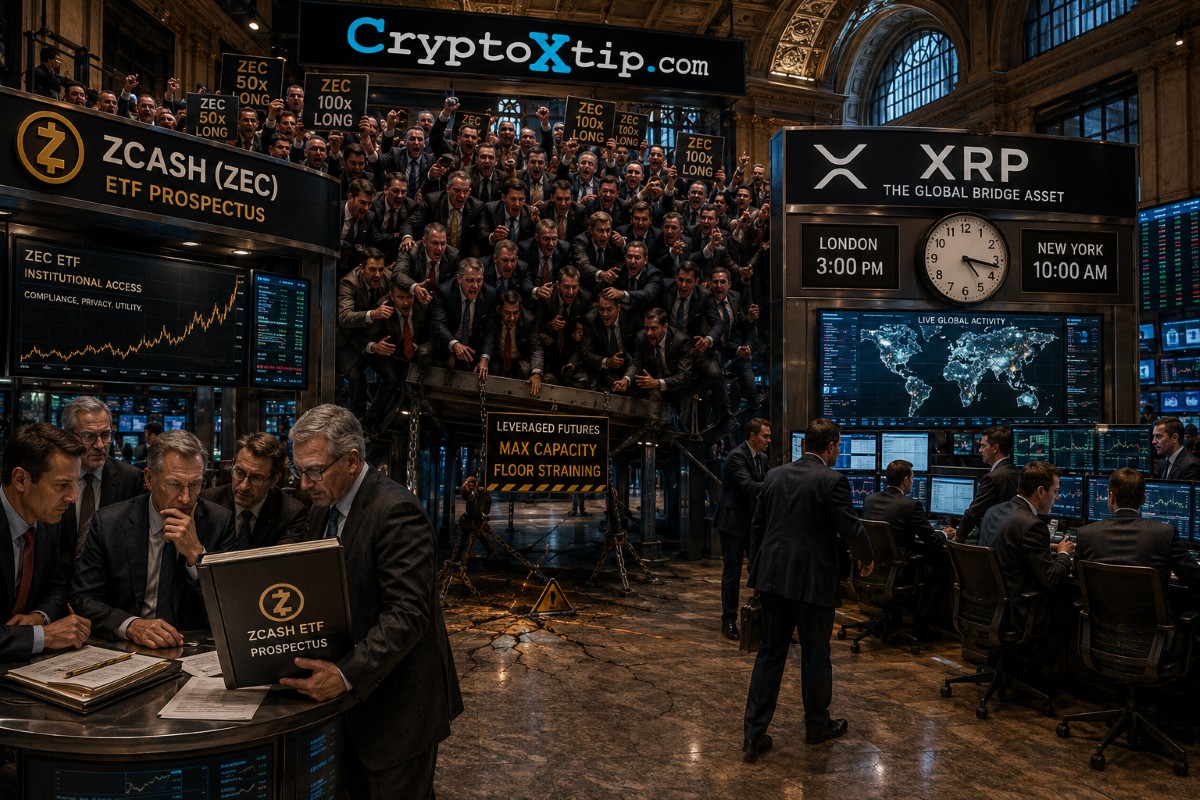
Zcash has surged to its highest level since 2018 as ETF momentum and derivatives speculation collide, while XRP activity increasingly follows Wall Street hours.
Zcash has abruptly become one of the crypto market's hottest altcoins, combining a powerful price breakout with renewed institutional interest in privacy-focused assets. ZEC surged as high as roughly $851 during Saturday trading, reaching levels not seen since 2018 and extending a rally that has transformed the token from a relatively quiet corner of the market into one of its most closely watched speculative trades.
The move has several ingredients. Grayscale has been advancing the conversion of its existing Zcash Trust into an exchange-traded fund, providing investors with a potentially easier route to ZEC exposure. At the same time, derivatives activity has expanded dramatically, suggesting that leverage has played an important role in accelerating the rally.
That combination creates both opportunity and risk. Institutional access can strengthen the longer-term investment case for an asset, while highly leveraged futures activity can produce price movements that are considerably less durable. Zcash currently has plenty of both.
Elsewhere in the altcoin market, XRP is producing a different institutional signal. On-chain data shows that an increasingly large share of activity on the XRP Ledger occurs during the overlap between London and New York business hours, suggesting that the network's trading rhythm is beginning to resemble traditional financial markets more closely.
Zcash Returns to Levels Last Seen in 2018
Zcash's weekend rally was unusually aggressive even by crypto standards.
ZEC traded between roughly $589 and $851 within a 24-hour period on Saturday, according to market data reported by CoinDesk. The move carried the privacy-focused cryptocurrency beyond its January 2018 peak near $800 and above the levels reached during its previous major rally.
That volatility illustrates how quickly positioning has changed.
Zcash has existed since 2016 and shares several monetary characteristics with Bitcoin, including a maximum supply of 21 million coins, proof-of-work mining and a halving schedule. Its defining feature is privacy: shielded transactions allow users to conceal information that would ordinarily remain visible on a public blockchain.
Privacy coins have spent years occupying an uncomfortable position within crypto. Their technology appeals to users who consider financial confidentiality a legitimate requirement, while regulators and exchanges have historically worried about their potential use in illicit transactions.
That tension makes the emergence of a regulated U.S. investment product particularly notable.
Grayscale Pushes Zcash Toward an ETF
Grayscale has been working to convert its existing Zcash Trust into an ETF listed on NYSE Arca under the ticker ZCSH.
The asset manager filed its fifth amended registration statement with the U.S. Securities and Exchange Commission on August 21. The filing renamed the proposed product The Zcash ETF and established an annual sponsor fee of 2.5%.
The repeated amendments indicated that the regulatory process was advancing rather than standing still. For traders, that progress became an important catalyst because an exchange-traded product could broaden access to ZEC among investors who prefer conventional brokerage infrastructure over direct crypto custody.
The story subsequently moved beyond speculation. Grayscale launched ZCSH on NYSE Arca on August 25 after converting the existing trust, creating the first U.S. ETF offering direct exposure to Zcash.
That distinction matters for the current market narrative. ZEC's initial rally was fueled partly by expectations surrounding the conversion process, but investors can now evaluate actual ETF demand rather than simply trading the possibility of approval.
Crypto occasionally spends months buying the rumor. Having an actual product afterward is a useful change of pace.
DCG Adds Another Layer to the Story
The ETF process has also included another potentially important source of demand.
An earlier regulatory amendment disclosed that DCG International Investments, a subsidiary connected to Grayscale parent Digital Currency Group, was in nonbinding discussions to acquire approximately 200,000 ZEC through the trust.
The proposed transaction was not guaranteed, and investors should not treat discussions as completed purchases. Still, its potential scale attracted attention because Zcash is considerably less liquid than Bitcoin or Ethereum.
Large purchases can therefore have a disproportionate impact on market expectations.
The involvement of companies connected to Digital Currency Group also illustrates why investors need to separate structural demand from speculative positioning when analyzing the rally. ETF conversion, potential institutional allocations and renewed interest in privacy technology can support a longer-term thesis. Rapid derivatives expansion is a different phenomenon entirely.
Derivatives Are Adding Serious Heat
Zcash's futures market provides the strongest reason for caution.
CoinDesk Data showed approximately $4.55 billion in ZEC futures trading volume on Friday, compared with roughly $553 million in spot activity. Futures open interest stood near $1.35 billion.
Those figures show that leveraged speculation has become a major component of the market.
Derivatives are not inherently bearish or unhealthy. Futures allow traders to hedge positions, improve price discovery and express views without immediately moving spot assets. Problems arise when leverage expands faster than underlying liquidity.
During a rally, leveraged long positions can amplify upward momentum. If prices reverse, the same structure can produce forced liquidations as exchanges close positions that no longer meet collateral requirements.
That makes ZEC vulnerable to unusually violent corrections even if the broader investment narrative remains constructive.
Investors should therefore distinguish between growing interest in Zcash and the speed of its latest price movement. The first may prove durable. The second is being assisted by a derivatives market that has clearly discovered the accelerator.
Privacy Is Becoming Investable Again
The larger question is whether Zcash's revival represents something more significant than another altcoin rally.
Privacy has become increasingly relevant as financial activity moves onto transparent digital infrastructure. Public blockchains provide extraordinary auditability, but that transparency creates obvious complications for businesses and individuals who do not want every financial relationship permanently visible.
Institutional adoption may actually strengthen the argument for selective privacy rather than weaken it.
Corporations routinely protect payroll information, supplier relationships, trading strategies and customer transactions. Financial institutions similarly operate under strict confidentiality requirements. A future where more assets settle on public blockchains will require mechanisms capable of balancing regulatory compliance with legitimate financial privacy.
Zcash supporters believe zero-knowledge technology provides one possible answer.
Critics remain unconvinced that privacy coins can overcome their regulatory history, particularly when governments remain concerned about anti-money-laundering enforcement and sanctions compliance. An ETF does not eliminate those questions.
It does, however, demonstrate that the institutional conversation around privacy assets is evolving.
XRP Develops Its Own Institutional Pattern
XRP has simultaneously produced another intriguing signal of changing altcoin market structure.
Data from the XRP Ledger analyzed by treasury company Evernorth and reported by CoinDesk shows that approximately 23% of XRP moving on-chain now does so during a three-hour window covering the London afternoon and New York morning.
A year earlier, that share was approximately 14%.
The window represents only 12.5% of a full 24-hour day, meaning XRP Ledger activity during those hours is running at nearly twice the rate expected if transactions were distributed evenly throughout the day.
The pattern appears across the ledger's order books, automated market maker pools and cross-currency payments.
There is an obvious reason analysts find this interesting: London and New York are the world's two most important Western financial centers, and their overlapping working hours represent one of the busiest periods in global foreign-exchange trading.
Banker Hours Do Not Prove Bankers
The data needs careful interpretation.
Concentrated activity during London-New York hours does not prove that institutions are responsible for the transactions. Retail traders, arbitrage firms and automated strategies are also particularly active during this period, while major U.S. market and regulatory news tends to arrive during the same window.
Evernorth argues that the shift is consistent with growing institutional participation, but consistency is not confirmation.
Still, the trend is worth monitoring because it coincides with other evidence of larger orders and increased professional interest around XRP.
The token has also experienced a substantial rally alongside the broader crypto market. By August 26, CoinDesk reported that XRP had risen roughly 44% over the preceding week, while futures open interest had climbed to about $3.45 billion.
That leverage creates risks similar to those visible in Zcash. Strong momentum attracts additional positioning, but crowded long trades can become vulnerable when markets reverse.
Altcoins Are Entering a Different Market
Zcash and XRP illustrate two different ways institutionalization can appear in altcoin markets.
For Zcash, the signal is explicit: a regulated ETF now provides direct exposure to a privacy-focused cryptocurrency through traditional financial infrastructure.
For XRP, the evidence is behavioral. Network activity is increasingly concentrated during the same hours when professional financial markets are busiest.
Neither development guarantees higher prices.
ZEC remains exposed to extreme derivatives speculation and the longstanding regulatory debate surrounding privacy assets. XRP's changing activity pattern cannot identify who is actually conducting transactions, while its rapidly expanding futures leverage creates its own downside risk.
Still, both developments suggest that institutional involvement in crypto is broadening beyond Bitcoin and Ethereum. Additional ecosystem coverage from Crypto X Tip increasingly reflects the same shift: investors are evaluating altcoins not simply through narratives and token prices, but through regulated products, liquidity, network usage and observable market structure.
What This Means
Zcash's extraordinary rally has transformed ZEC into one of the market's most closely watched altcoins. The move toward $850 was supported by genuine developments around Grayscale's ETF conversion, which has now produced the first U.S. exchange-traded fund directly tracking Zcash. That gives the privacy-coin narrative a level of traditional financial access it has never previously enjoyed.
The caution comes from derivatives. Futures activity has dramatically exceeded spot trading, indicating that leverage is contributing heavily to current volatility. Zcash may have a stronger institutional story than it did several weeks ago, but its price is also being pushed around by traders borrowing conviction.
XRP offers a quieter but potentially important signal. The growing concentration of XRP Ledger activity during London-New York business hours is consistent with greater professional participation, although it cannot prove institutions are responsible. Together, the two stories suggest that altcoins are attracting more sophisticated capital—and more sophisticated leverage. Crypto, naturally, has found a way to institutionalize both opportunity and risk.
Related Articles
More stories you may want to explore.


Sponsored Placements











