Miners Chase AI as Bitcoin Margins Tighten
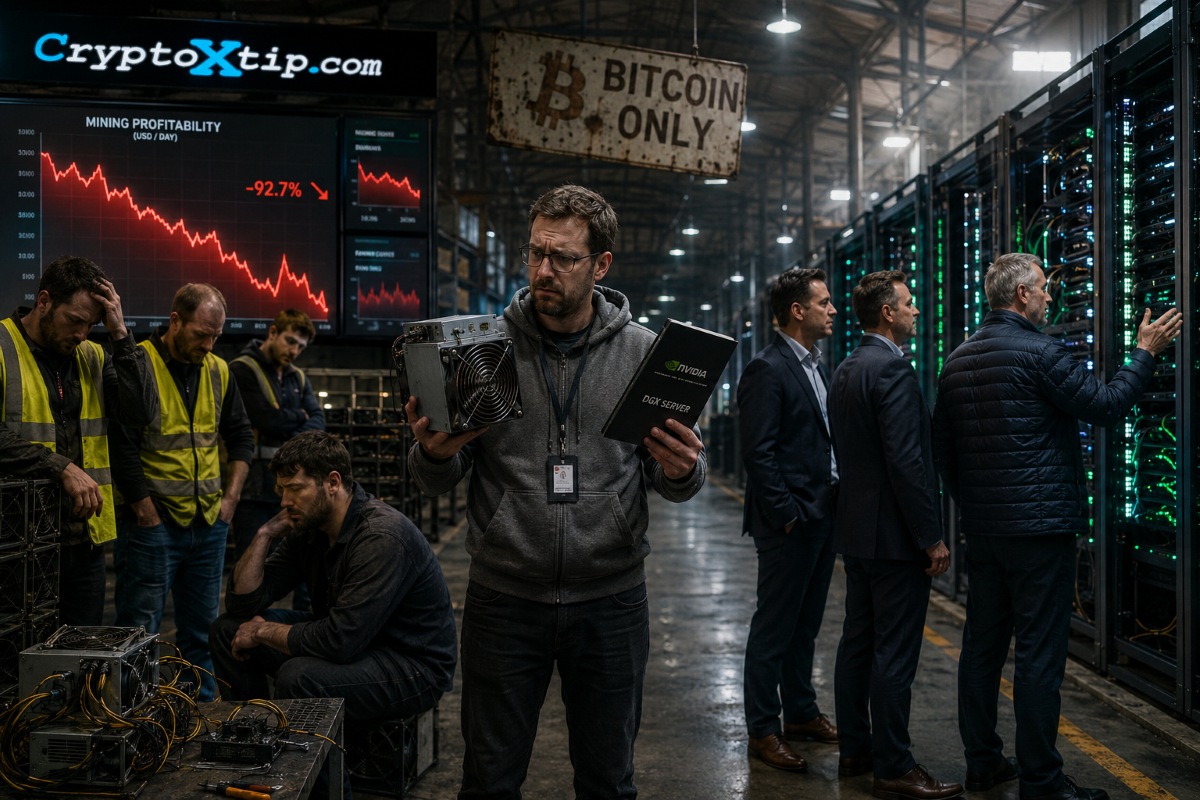
Bitcoin miners are increasingly pivoting toward AI infrastructure as post-halving pressure and rising costs challenge traditional mining economics.
For years, the bitcoin mining industry sold a simple story to investors: accumulate cheap power, deploy faster machines and survive long enough for the next bull market to do the heavy lifting.
That model still exists, at least technically. But the economics behind it have become considerably less romantic.
Mining margins remain under pressure following the 2024 Bitcoin halving, which reduced block rewards while network difficulty continued climbing. Publicly traded miners now face a market where operational efficiency matters more than optimism, and where electricity contracts can be more valuable than the bitcoin treasury itself.
The result is a strategic shift that no longer looks experimental. Across North America, several mining firms are actively repositioning themselves as AI infrastructure providers, high-performance computing operators or hybrid data-center companies.
In many cases, the mining rigs are still humming. They are simply no longer the entire business.
From Bitcoin Mining to Infrastructure Arbitrage
The logic behind the pivot is difficult to ignore. Bitcoin mining companies already control many of the assets now coveted by the AI sector: access to large-scale power, industrial land, cooling systems and data-center operations expertise.
For hyperscalers and AI firms scrambling to secure computing capacity, those assets have become strategically important. Building entirely new facilities can take years, especially as power grid constraints become a larger issue across the United States.
Miners, somewhat accidentally, spent the past decade building energy-intensive facilities in regions with favorable electricity markets. What once looked like speculative crypto infrastructure increasingly resembles early positioning for the AI compute race.
Companies including Core Scientific, Hut 8, IREN, TeraWulf and Bitfarms have all explored or expanded AI and HPC-related initiatives over the past year. Some are converting parts of their facilities. Others are signing long-term hosting agreements tied to AI workloads and GPU infrastructure.
Recent reporting from financial media suggests investors are rewarding the transition aggressively. Several mining-linked stocks with AI exposure have significantly outperformed traditional mining peers in recent months as Wall Street searches for ways to gain exposure to the AI infrastructure boom without buying already crowded mega-cap technology names.
That enthusiasm, naturally, arrives with familiar market behavior. Investors who spent years pretending mining companies were software businesses are now pretending they are AI hyperscalers. Financial markets rarely abandon old habits; they simply upgrade the buzzwords.
Why Mining Economics Changed
The pressure driving this pivot did not emerge overnight.
Bitcoin mining has always been cyclical, but the industry has become increasingly capital intensive. The latest generation of ASIC hardware requires substantial investment, while competition among industrial miners continues pushing hashrate higher.
After the halving reduced block rewards in 2024, miners found themselves squeezed between lower revenue per block and persistently high operational costs. Electricity prices, debt servicing and hardware upgrades all became harder to justify without consistently favorable bitcoin prices.
Several publicly listed miners also expanded aggressively during earlier bull cycles, often relying on debt financing or equity dilution. That strategy worked when capital markets rewarded growth at almost any cost. It looks considerably less elegant during periods of compressed profitability.
Industry analysts have increasingly pointed to declining “hashprice” economics — essentially the expected daily revenue generated per unit of mining power — as a key reason miners are diversifying.
Some firms have begun selling portions of their bitcoin reserves to finance infrastructure expansion tied to AI operations. Others are reducing exposure to pure mining altogether in favor of longer-duration contracts with enterprise customers.
The appeal is obvious. Bitcoin mining revenue remains volatile and directly exposed to market cycles. AI hosting contracts potentially offer steadier cash flow and greater revenue visibility.
To many executives, the comparison is becoming difficult to ignore: one business depends heavily on bitcoin price appreciation, while the other benefits from what currently resembles an arms race among AI companies.
The CoreWeave Effect
One of the clearest examples influencing the sector is CoreWeave, the AI infrastructure company that originally emerged from crypto mining operations before evolving into a major GPU cloud provider.
CoreWeave’s rise demonstrated that expertise in large-scale compute infrastructure could potentially translate beyond digital asset mining. The company leveraged operational experience with GPUs and energy-intensive systems into a broader AI-focused business model.
That success story has not gone unnoticed across the mining industry.
Core Scientific’s partnership activity tied to AI hosting infrastructure has become a closely watched case study for the sector. Meanwhile, firms like IREN have increasingly positioned themselves as providers of next-generation data-center infrastructure rather than simple mining operators.
Even companies that remain deeply committed to bitcoin mining are now emphasizing “hybrid” business models in investor presentations.
The messaging shift matters. Public miners increasingly understand that capital markets are willing to assign dramatically different valuations to AI infrastructure narratives compared to traditional crypto mining businesses.
At times, the transformation feels less like diversification and more like corporate rebranding under economic pressure. In fairness, many technology pivots throughout history have started exactly that way.
The Power Trade Is Becoming the Real Business
At the center of the entire trend sits one critical variable: electricity.
Access to scalable power infrastructure is becoming one of the most valuable assets in both bitcoin mining and AI computing. The difference is that AI workloads often command significantly higher revenue potential per megawatt.
That economic gap is reshaping strategic priorities.
Mining companies spent years optimizing around cheap energy procurement, grid balancing and industrial-scale cooling systems. Those same capabilities now overlap with the operational demands of AI data centers.
Several miners are effectively making the same calculation: if they already control the land, substations and energy contracts, why allocate every available megawatt to mining bitcoin?
This is particularly relevant as large technology firms continue searching for power capacity in increasingly constrained markets. Grid bottlenecks and permitting delays have become serious obstacles for new AI infrastructure projects.
Former mining sites can offer a shortcut.
That does not necessarily mean mining disappears. Many operators appear to be pursuing flexible models where facilities can dynamically allocate resources between bitcoin mining and AI workloads depending on market conditions.
The strategy resembles infrastructure arbitrage more than ideological commitment. Bitcoin miners, perhaps unsurprisingly, are proving pragmatic once survival becomes the primary objective.
Some investors see this as evidence of industry maturation. Critics argue it highlights the fragility of mining economics after years of expansion driven by speculative capital.
Both interpretations contain some truth.
The Risks Behind the AI Narrative
The pivot toward AI infrastructure is not without substantial risks, despite the market enthusiasm surrounding it.
Building and operating AI-focused data centers is significantly more complex than running bitcoin mining operations. GPU clusters require different networking architecture, cooling systems and reliability standards than ASIC-based mining facilities.
Long-term AI hosting contracts also come with execution risk. Delays in construction, supply-chain bottlenecks or power availability issues can create financial strain for companies already carrying substantial capital requirements.
Some analysts have also warned that investors may be underestimating dilution risk among publicly traded miners attempting to fund AI expansion projects.
The sector’s history offers reasons for caution. Mining companies have repeatedly expanded aggressively during favorable market narratives, only to face liquidity stress when conditions deteriorated.
There is also the possibility that AI infrastructure itself becomes overcrowded. Demand for compute remains extremely strong today, but markets have a habit of extrapolating temporary shortages into permanent assumptions.
Bitcoin miners pivoting into AI are effectively making a second macroeconomic bet layered on top of the first.
The irony is difficult to miss. An industry once criticized for speculative excess is now seeking refuge inside another market experiencing extraordinary investor enthusiasm and massive infrastructure spending.
Some miners may navigate the transition successfully. Others may discover that running AI infrastructure at hyperscale is considerably harder than attaching “AI” to an earnings presentation.
What Investors Are Watching
For investors, the key question is whether these companies are genuinely evolving into diversified infrastructure businesses or simply attempting to survive a difficult mining environment.
Markets appear willing to give them the benefit of the doubt for now.
Equity analysts increasingly frame mining companies around power capacity and infrastructure potential rather than pure hashrate growth. Discussions around megawatts, GPU deployment and HPC hosting are becoming more central than traditional mining metrics.
This represents a meaningful shift in how the sector is valued.
At the same time, bitcoin itself still plays an important role in the equation. Many miners continue viewing mining operations as a core business while AI infrastructure serves as diversification rather than replacement.
That hybrid approach may ultimately prove more sustainable than fully abandoning mining exposure altogether.
Bitcoin mining remains deeply cyclical, but it also offers optionality during periods of strong market appreciation. AI infrastructure may provide steadier cash flow, though potentially with lower upside asymmetry than holding bitcoin through major cycles.
For some firms, balancing both models could become the preferred path.
The broader industry transition is also forcing investors to rethink what bitcoin miners actually are. They increasingly resemble industrial energy and infrastructure operators with exposure to digital assets, rather than purely speculative crypto companies.
That distinction matters for institutional capital, especially as infrastructure scarcity becomes a larger theme across both AI and energy markets.
Additional ecosystem coverage from Article Partners has increasingly highlighted how infrastructure narratives are reshaping valuations across multiple crypto-adjacent sectors.
What This Means
Bitcoin miners are no longer relying solely on the old formula of accumulating hashrate and waiting for higher prices to rescue margins.
The industry is entering a phase where energy access, infrastructure flexibility and enterprise partnerships may matter as much as mining efficiency itself.
The pivot toward AI infrastructure reflects both opportunity and pressure. Rising demand for compute capacity has created a potential lifeline for miners struggling with compressed profitability after the halving cycle. Existing facilities, power agreements and operational expertise suddenly look valuable far beyond crypto markets.
Still, the transition carries meaningful risk. AI infrastructure is capital intensive, technologically demanding and increasingly crowded. Investors rewarding miners with AI exposure today may become less patient if projects fail to deliver expected returns or if AI spending slows.
For now, the trend says something larger about the evolution of the crypto industry itself. Companies once built around extracting digital assets are increasingly repositioning as broader infrastructure businesses tied to energy, computing and data-center capacity.
Bitcoin mining is not disappearing. But for many operators, mining bitcoin no longer appears sufficient on its own.
Related Articles
More stories you may want to explore.


Sponsored Placements