
Bitcoin Rally Lifts Mining Stocks
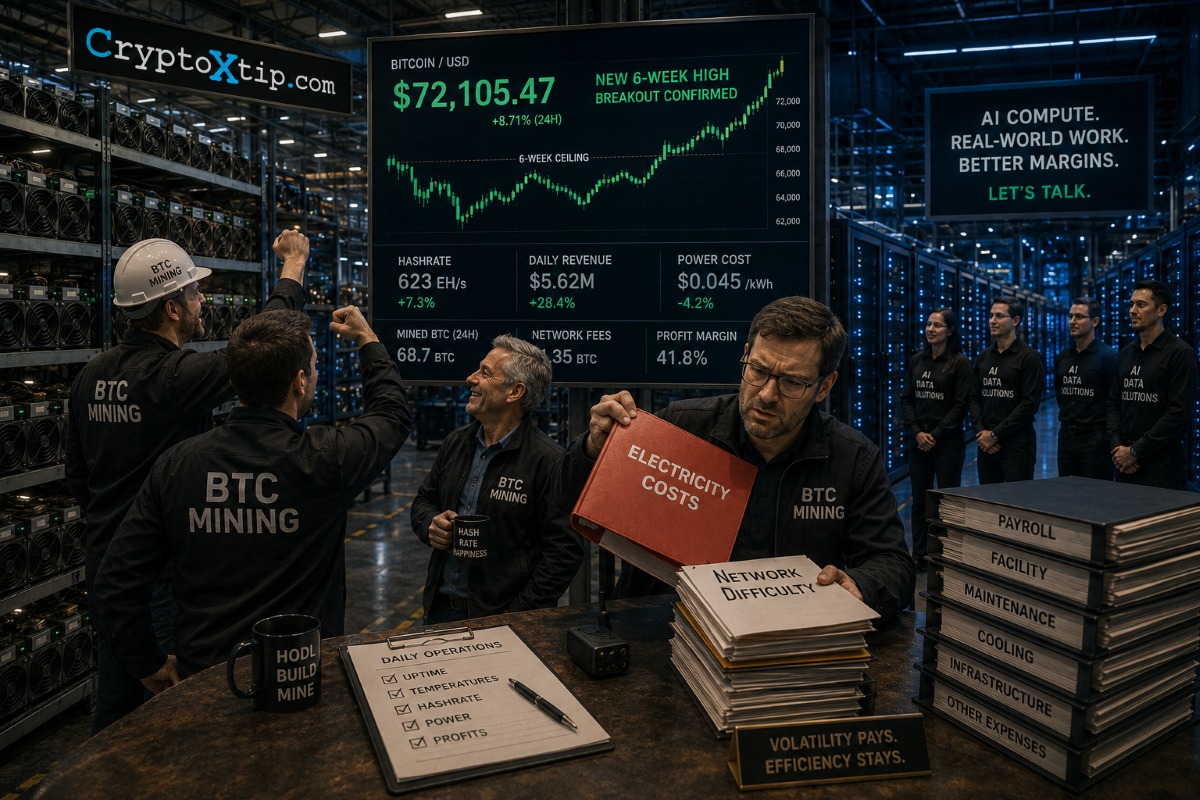
Bitcoin’s return above $70,000 has revived mining shares, but difficult operating economics mean miners remain a volatile leveraged bet on BTC.
Bitcoin miners finally received something they have been missing for much of the year: help from Bitcoin itself.
As BTC broke above $70,000 during last week's sharp risk-on rally, publicly traded cryptocurrency companies moved higher alongside it. Reuters reported particularly strong gains across crypto-linked equities after the U.S. Treasury expanded buybacks of longer-dated government debt and regulatory expectations improved in Washington. Canaan stood out, rising more than 10% during the session.
For Bitcoin mining companies, the logic behind the rally is straightforward. Miners generate revenue largely in BTC while paying much of their operating expenses in traditional currencies. A higher Bitcoin price therefore improves the dollar value of production and can quickly change expectations around margins, liquidity and balance-sheet strength.
That does not mean the industry's problems disappeared when Bitcoin crossed a round number on a trading screen. Mining economics remain demanding, production has weakened at several major operators, and competition for both electricity and capital continues to intensify. Mining stocks may benefit disproportionately when BTC rises, but the same operating leverage can become considerably less entertaining when Bitcoin moves in the opposite direction.
Bitcoin Gives Miners Some Breathing Room
The immediate catalyst came from the broader crypto rally rather than any mining-specific breakthrough.
Bitcoin climbed back above $70,000 as investors responded positively to the Treasury's decision to expand certain long-duration bond buybacks. Markets interpreted the move as supportive for financial conditions after pressure in the government bond market had pushed long-term yields sharply higher. More constructive expectations around U.S. crypto regulation added another tailwind.
Crypto equities responded quickly. Reuters reported that Coinbase gained about 6% during the session, Strategy advanced roughly 4%, and Canaan jumped 10.37%. Circle also moved higher.
Canaan's reaction was especially relevant for the mining sector because the company operates both a Bitcoin mining business and one of the industry's established ASIC hardware businesses.
The rally demonstrated the sensitivity of mining equities to changes in Bitcoin sentiment. Investors frequently treat miners as higher-beta proxies for BTC because relatively small changes in the cryptocurrency's price can produce much larger changes in expectations for mining profitability.
Why Higher BTC Matters So Much
Bitcoin mining is ultimately a margin business.
Operators compete for a fixed block subsidy and transaction fees while carrying substantial expenses for electricity, machines, cooling, facilities, employees and financing. Network difficulty adds another variable because miners must continuously compete against growing global computing power.
When Bitcoin rises, each coin produced becomes more valuable in dollar terms. Electricity bills do not automatically increase at the same rate, meaning stronger BTC prices can expand operating margins for efficient miners.
The effect can be particularly powerful for companies holding Bitcoin on their balance sheets. A rally may simultaneously improve the economics of future production and increase the market value of previously mined reserves.
Equity investors tend to anticipate those changes rather than wait for them to appear in quarterly earnings.
That is why mining shares can occasionally behave like Bitcoin after several espressos.
The Industry Is Still Under Pressure
The recent share-price rally should not obscure the difficult operating environment miners have faced.
CoinDesk reported earlier in August that Bitcoin mining difficulty had fallen roughly 14% from its 2026 high as deteriorating economics forced some operators to reduce capacity or reconsider their strategies. The decline offered some relief to miners that remained active, but it also illustrated how severe the pressure had become.
Production data provides another reminder.
The Block reported that CleanSpark, BitFuFu and Canaan each recorded lower Bitcoin production in July for a second consecutive month. CleanSpark produced 586 BTC during the month, down roughly 5% from June, while Canaan's production also declined.
Financial results have been similarly uneven. MARA reported second-quarter revenue of $174.9 million, down 27% year over year, while CleanSpark reported quarterly revenue of $138 million, down 30.5% from the comparable period. Both companies have been expanding into high-performance computing and artificial intelligence infrastructure as traditional mining economics remain challenging.
Bitcoin above $70,000 improves the equation. It does not rewrite it.
Miners Remain Leveraged Bitcoin Plays
The relationship between mining equities and Bitcoin deserves particular attention from investors.
Owning shares in a miner is fundamentally different from owning BTC.
Bitcoin itself does not have employees, debt obligations, electricity contracts or data centers requiring constant capital expenditure. Mining companies have all of them.
That corporate structure creates both opportunity and additional risk.
During a strong Bitcoin rally, miners can outperform because revenue expectations improve faster than many operating expenses. If investors also expect stronger margins and healthier balance sheets, equity valuations can expand alongside earnings expectations.
During falling markets, the process reverses. Revenue contracts while many costs remain stubbornly real. Highly leveraged operators can then face pressure to sell Bitcoin reserves, raise equity, restructure debt or shut down inefficient machines.
This makes mining stocks an imperfect but often highly responsive leveraged expression of Bitcoin exposure.
AI Is Changing the Mining Thesis
Another complication is that some of the largest miners increasingly look less like pure Bitcoin companies.
Access to power infrastructure has become extraordinarily valuable as artificial intelligence companies search for data-center capacity. Bitcoin miners already control large electrical connections, land and cooling infrastructure, making some facilities potentially suitable for conversion to high-performance computing.
The trend has become substantial enough that several companies are actively shifting capital away from Bitcoin mining.
Keel Infrastructure, formerly Bitfarms, recently decommissioned all of its U.S. Bitcoin mining operations as it prepares those sites for AI and high-performance computing workloads.
Others are pursuing hybrid models. Bitdeer, MARA and CleanSpark have all attracted attention for their efforts to combine Bitcoin mining infrastructure with opportunities linked to AI computing.
For shareholders, this creates an interesting valuation question. A mining company may benefit from rising Bitcoin prices while simultaneously owning infrastructure that could potentially earn higher returns serving AI customers.
The mining sector is therefore becoming less homogeneous. Investors increasingly need to evaluate each company based on energy costs, fleet efficiency, financing, BTC reserves and data-center strategy rather than simply asking whether Bitcoin is going up.
Higher Prices Can Also Increase Competition
A stronger Bitcoin price brings another consequence that miners know well: competition eventually follows profitability.
When mining becomes more attractive, companies have greater incentive to activate additional machines or expand capacity. That can push network hashrate and difficulty higher, gradually reducing the amount of Bitcoin individual operators earn from a given amount of computing power.
The industry's economics therefore contain their own balancing mechanism.
Higher BTC prices initially improve margins. Better margins encourage additional computing power. Additional computing power increases difficulty. Rising difficulty then squeezes margins again.
For the strongest miners, this cycle can create opportunities to gain market share from less efficient competitors. For weaker operators, it can transform temporary relief into another capital-spending race.
Investors Should Watch Cash Flow, Not Just BTC
The current rally has understandably renewed investor interest in mining equities, but Bitcoin's price should not be the only metric driving analysis.
Energy efficiency remains critical. So do debt levels, dilution, access to low-cost electricity, machine age and the ability to fund expansion without repeatedly tapping shareholders.
Bitcoin treasury management is another increasingly important variable. CoinDesk recently identified public miners as a meaningful source of market supply, estimating that the group had generated roughly $1.78 billion of selling pressure as companies monetized production and reserves to finance operations.
A sustained Bitcoin rally could reduce some of that pressure by improving operating cash generation. Conversely, another prolonged decline could force weaker companies back toward treasury sales or capital markets.
That makes balance-sheet resilience especially important when comparing miners. Additional ecosystem coverage from Crypto X Tip similarly reflects a market where corporate financing decisions increasingly matter alongside Bitcoin's underlying price trend.
What This Means
Bitcoin's return above $70,000 has provided a meaningful boost to publicly traded mining companies, with Canaan's double-digit move illustrating how quickly sentiment can change when BTC rallies. Higher Bitcoin prices improve the revenue side of mining economics and can materially strengthen expectations for margins and cash generation.
Yet the sector remains far from easy. Production has declined at several operators, mining difficulty continues to challenge profitability, and some companies are diversifying aggressively into AI infrastructure because Bitcoin mining alone no longer offers the growth profile investors once expected.
For investors, mining stocks remain a high-volatility way to express a bullish view on Bitcoin—but with electricity bills, corporate debt, dilution and management decisions added to the package. Bitcoin only has to be Bitcoin. Miners still have to run a business.
Related Articles
More stories you may want to explore.



Sponsored Placements











