
CLARITY Act Could Redraw Crypto’s Legal Map
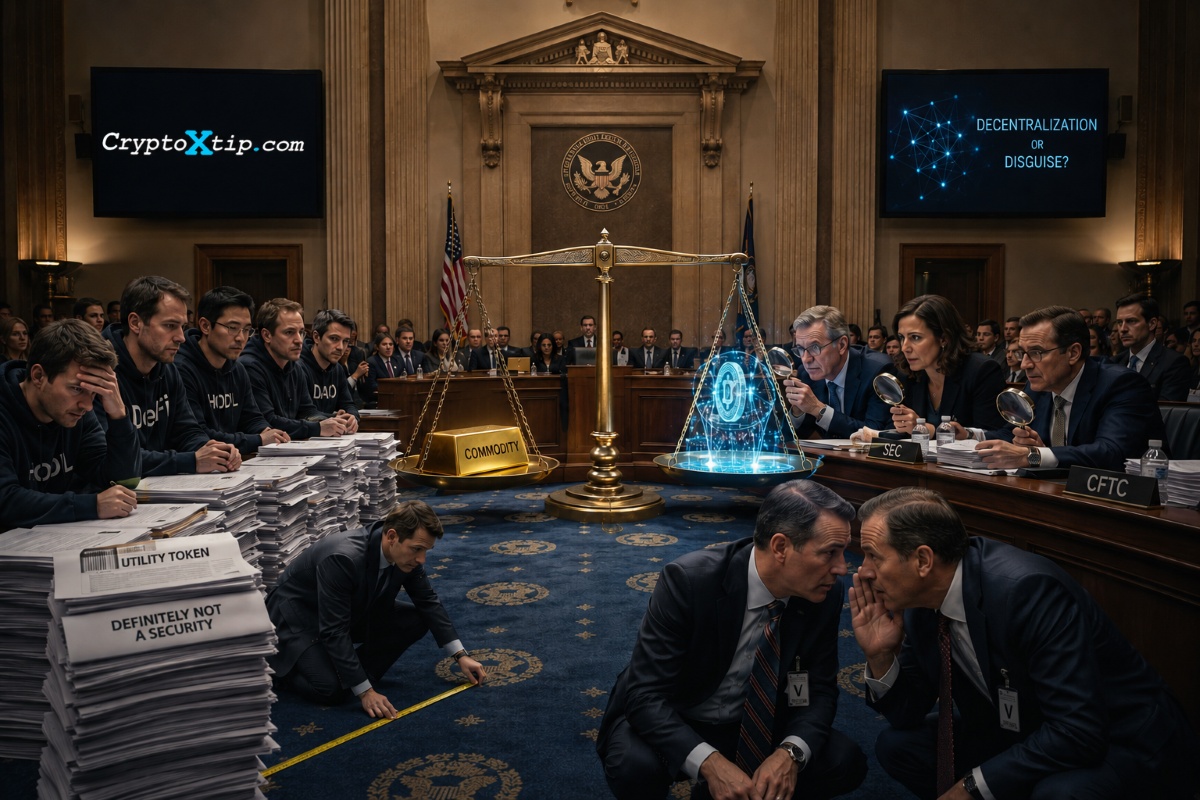
The U.S. Senate Banking Committee is set to review the CLARITY Act on May 14, a proposal that could finally define when crypto tokens are treated as securities or commodities in the United States.
For years, the American crypto industry has operated inside a regulatory paradox. Tokens traded on exchanges with commodity-like behavior were often pursued by the Securities and Exchange Commission as unregistered securities. Projects claimed decentralization while raising capital in ways regulators viewed as traditional investment contracts. Exchanges listed assets without clear federal guidance, then discovered years later that legal interpretations could shift with a lawsuit or a speech from Washington.
That ambiguity may now face its most serious challenge yet.
The U.S. Senate Banking Committee is scheduled to review the CLARITY Act on May 14, legislation designed to establish a formal market structure framework for digital assets. At the center of the proposal is a question that has haunted the crypto market since Ethereum stopped being a whitepaper experiment and became an industry benchmark: when exactly does a token stop being a security and become something closer to a commodity?
It is not the sort of question that inspires meme coins or laser-eye profile pictures. Still, it may prove more important to the industry’s long-term survival than another ETF launch or another round of speculative enthusiasm.
The Regulatory Fight That Never Ended
The conflict between the SEC and the Commodity Futures Trading Commission has shaped nearly every major crypto enforcement action in the United States over the past several years.
Under former SEC leadership, regulators repeatedly argued that most crypto tokens met the definition of securities under the decades-old Howey Test. The agency relied heavily on enforcement rather than bespoke rulemaking, creating a system where exchanges, developers and investors often learned regulatory boundaries through lawsuits rather than published standards.
The CFTC, by contrast, generally argued for a more commodities-oriented approach, particularly for decentralized assets trading in secondary markets. The absence of clear congressional guidance left both agencies claiming overlapping authority.
The result was predictable. Projects faced years of uncertainty. Venture funding shifted offshore. Token issuers hired armies of lawyers before hiring product developers. Retail traders discovered that assets available on major exchanges one month could become legal liabilities the next.
Even court decisions failed to fully settle the debate. The Ripple litigation created one of the clearest examples of judicial inconsistency in crypto regulation. Certain token sales were interpreted differently depending on how and where they occurred, reinforcing the idea that digital assets could behave like securities in one context and commodities in another.
Financial markets dislike uncertainty. Crypto markets simply price it with more drama and less sleep.
What the CLARITY Act Actually Tries to Do
The CLARITY Act aims to establish a clearer division of authority between the SEC and the CFTC. In broad terms, the proposal attempts to define when a digital asset falls under securities law and when it qualifies as a digital commodity.
According to draft summaries and legislative reporting, the bill would create formal standards for evaluating decentralization, token distribution and network control. Assets sufficiently decentralized over time could potentially transition away from securities classification and into a commodity framework overseen primarily by the CFTC.
That transition mechanism may become the bill’s most consequential feature.
Crypto projects rarely remain static. Many networks begin with centralized fundraising and governance before evolving toward wider distribution and decentralized validation. Existing securities law was never built with that lifecycle in mind. The CLARITY Act attempts to account for it directly.
The proposal also reportedly includes provisions around disclosures, customer asset segregation and operational standards for exchanges and intermediaries. Those measures appear designed to respond to the post-FTX political reality in Washington, where lawmakers increasingly understand the difference between crypto infrastructure and outright corporate negligence.
Few politicians want another televised exchange collapse. Even fewer want to explain afterward why customer assets were apparently managed with the accounting discipline of a casino minibar.
Why Markets Are Watching Closely
The importance of the legislation extends beyond legal theory.
Institutional participation in crypto markets has grown steadily since the approval of spot Bitcoin ETFs and broader integration of digital assets into traditional finance. Yet many institutions remain cautious about direct exposure to token ecosystems beyond Bitcoin and Ethereum because regulatory treatment remains uncertain.
For large financial firms, ambiguity creates operational risk. Compliance departments tend to dislike products that might retroactively become illegal depending on which agency chair appears before Congress next quarter.
Clearer rules could change that calculus significantly.
If the CLARITY Act establishes durable standards for token classification, exchanges may gain more confidence listing assets, institutional custodians could expand offerings and venture investors might re-enter sectors that became legally radioactive during the SEC’s enforcement-heavy years.
That does not necessarily mean immediate market euphoria. Regulation often arrives slower than industry expectations and usually with more paperwork than anyone enjoys reading. But legal predictability tends to attract capital over time, particularly in markets attempting to mature beyond speculative cycles.
Several analysts have also pointed out that the legislation could improve America’s competitive position globally. Jurisdictions including the European Union, Hong Kong and the UAE have already implemented more comprehensive crypto frameworks, while the United States spent years debating whether most tokens were simply securities wearing newer software.
Some developers responded by leaving. Others stayed and built anyway, operating with the legal certainty of someone assembling furniture without instructions.
The Political Reality Behind the Bill
Despite growing momentum, the CLARITY Act still faces substantial political hurdles.
Crypto legislation in Washington remains deeply polarized. Supporters argue that clear rules are essential for innovation, competitiveness and consumer protection. Critics warn the industry continues to carry systemic risks tied to speculation, money laundering and weak oversight.
Some Democratic lawmakers remain skeptical that current proposals go far enough in addressing decentralized finance, anti-money laundering obligations and investor safeguards. National security groups and financial watchdogs have also raised concerns that poorly structured crypto legislation could create loopholes for illicit finance.
The debate increasingly reflects a broader ideological divide over how digital assets should integrate into the traditional financial system.
One side views crypto as an emerging infrastructure layer requiring modern regulation. The other sees an industry still heavily driven by speculative excess, market manipulation and periodic collapses disguised as innovation.
To be fair, both perspectives contain uncomfortable amounts of truth.
The crypto industry has undeniably matured since the ICO era, yet large sections of the market still operate on narratives rather than fundamentals. Regulatory clarity may help separate sustainable infrastructure from projects surviving primarily on community slogans and venture funding nostalgia.
What It Could Mean for Tokens
The practical implications for token issuers could be enormous.
If lawmakers establish a workable framework distinguishing securities from commodities, many existing projects may attempt to restructure governance models, token distributions and operational control to fit within commodity classifications.
That could accelerate decentralization efforts across the industry. Networks may place greater emphasis on validator diversity, governance transparency and reduced insider control in order to avoid securities treatment.
At the same time, the legislation may expose projects that marketed themselves as decentralized while retaining highly concentrated control structures behind the scenes.
Crypto has always contained a peculiar tension between decentralization rhetoric and centralized economics. Some protocols describe themselves as community-owned ecosystems while still functioning like startups with tokens attached. The CLARITY Act could force more honest distinctions.
Secondary markets would also likely benefit from clearer guidance.
One of the most contentious issues in recent years involved whether tokens originally sold as securities should remain securities forever when traded on public exchanges. Several legal interpretations challenged the idea that all secondary market transactions automatically inherit the characteristics of the original sale.
Legislative clarification could significantly reduce uncertainty for exchanges and traders alike.
That matters because liquidity depends heavily on confidence in market structure. Traders may tolerate volatility. They are less enthusiastic about discovering that an asset’s legal status changes midway through a market cycle.
The Industry’s Lobbying Moment
The crypto sector has spent heavily on lobbying efforts in Washington over the past two years, and market structure legislation became one of the industry’s primary political objectives.
Executives increasingly realized that regulatory ambiguity represented a bigger long-term threat than short-term price volatility. Investors can survive bear markets. Businesses struggle more with unclear legal obligations enforced retroactively.
That shift altered the tone of crypto lobbying considerably.
The industry once framed regulation largely as an obstacle to innovation. More recently, major firms have argued for clear federal standards precisely because institutional adoption requires predictable oversight.
In many ways, the sector’s relationship with regulation now resembles a teenager discovering adulthood mainly involves paperwork and tax obligations.
The CLARITY Act reflects that broader transition from ideological resistance toward negotiated integration with existing financial systems.
Several firms have already begun positioning themselves for a more regulated future, investing heavily in compliance infrastructure, custody operations and relationships with traditional financial institutions. Additional ecosystem coverage from Article Partners has highlighted how aggressively exchanges and infrastructure providers are preparing for institutional participation if regulatory conditions stabilize.
A Long Road Even After Committee Review
Even if the Senate Banking Committee advances the legislation on May 14, the broader legislative path remains uncertain.
The bill would still require broader Senate approval, reconciliation with House versions and eventual presidential support. Amendments could significantly reshape key provisions during negotiations.
Stablecoin regulation may also remain a separate point of contention. Some lawmakers want tighter restrictions around yield products, reserve management and banking relationships tied to dollar-backed digital assets.
The broader political environment complicates matters further. Crypto regulation increasingly intersects with election politics, banking policy and debates over financial innovation more broadly.
That said, momentum around federal crypto legislation appears stronger than at any previous point in the industry’s history.
Washington’s posture toward digital assets has shifted noticeably from outright hostility toward reluctant engagement. Regulators and lawmakers increasingly appear to accept that crypto markets are unlikely to disappear, regardless of whether they personally enjoy the asset class.
At some point, governments usually stop asking whether a technology should exist and start asking how to regulate the version that already does.
What This Means
The CLARITY Act may become one of the most consequential crypto regulatory proposals ever seriously considered in the United States.
At its core, the legislation attempts to answer a foundational question the industry has avoided for years: what exactly are crypto tokens under American law?
If lawmakers successfully establish clearer boundaries between securities and commodities, the implications could extend across exchanges, token issuers, venture capital, institutional adoption and retail trading. Legal certainty would not eliminate volatility or speculation, but it could finally provide a more stable framework for market participation.
The crypto market has spent years operating inside legal gray zones while regulators, courts and companies argued over definitions written long before blockchain networks existed.
The Senate’s upcoming review suggests Washington may finally be moving from enforcement-by-ambiguity toward actual rulemaking.
For an industry built on decentralization, that moment carries a strange irony. Crypto once promised to operate outside traditional systems entirely. Now many of its largest participants are waiting for Congress to define the rules clearly enough so Wall Street can participate comfortably.
Markets evolve. Narratives evolve faster. Regulation, on the other hand, tends to arrive exactly when everyone is already exhausted from arguing about it.
Related Articles
More stories you may want to explore.



Sponsored Placements











