
CLARITY Act Boosts Crypto Stocks, but the Fight Isn’t Over
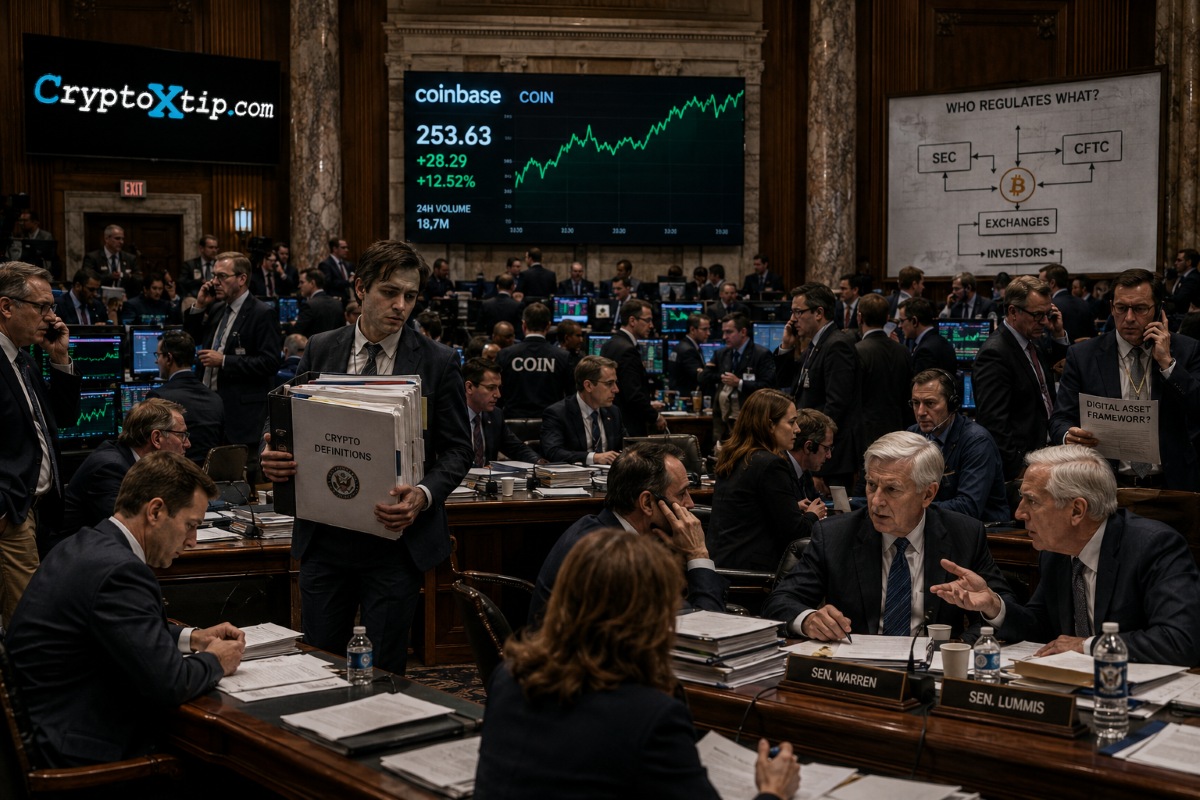
The CLARITY Act advanced in the U.S. Senate this week, boosting crypto stocks like Coinbase as investors welcomed signs of clearer digital asset regulation. Final approval, however, remains uncertain.
Crypto markets have spent years operating inside a regulatory environment that often resembled a legal scavenger hunt. Companies searched for clues, regulators improvised interpretations and investors learned to treat court rulings like macroeconomic events.
This week, Washington offered the industry something it rarely delivers: forward movement.
The U.S. Senate Banking Committee advanced the CLARITY Act in a bipartisan vote, pushing one of the most significant crypto market-structure bills closer to a full Senate debate. The development immediately lifted sentiment across crypto-linked equities, with shares of Coinbase, Robinhood and several mining-related firms rallying after the vote.
The reaction was not particularly subtle. Markets tend to respond enthusiastically whenever lawmakers appear willing to replace ambiguity with actual rules — especially after years of regulation through enforcement actions, lawsuits and contradictory guidance.
Still, the optimism comes with important caveats. The CLARITY Act has not become law, final approval remains uncertain and political divisions around crypto regulation are far from resolved.
For now, though, the bill’s progress represents something the industry has wanted for years: confirmation that U.S. lawmakers are seriously moving toward a formal regulatory framework for digital assets.
Why the Market Reacted
Crypto-related stocks moved higher shortly after the committee vote, with Coinbase becoming one of the most closely watched beneficiaries of the momentum. Investors broadly interpreted the Senate advance as a positive signal for companies that have spent years navigating uncertain oversight from both the Securities and Exchange Commission and the Commodity Futures Trading Commission.
The CLARITY Act aims to establish clearer distinctions between digital assets classified as securities and those treated as commodities. That distinction carries enormous implications for exchanges, token issuers and trading platforms operating in the United States.
Under the proposed framework, many crypto assets would likely fall under CFTC oversight rather than SEC jurisdiction — a long-standing objective for much of the industry.
Markets tend to reward predictability, even when the final rules are imperfect. For publicly traded crypto firms, the possibility of operating under a clearer regulatory structure matters more than endless legal uncertainty.
Recent reporting from financial media suggested investors viewed the Senate committee vote as one of the strongest regulatory catalysts for crypto equities in months. Coinbase shares climbed sharply after the announcement, while broader crypto sentiment also improved.
Bitcoin and several major digital assets also saw temporary upward momentum as traders interpreted the vote as evidence that Washington may finally be shifting away from an openly hostile stance toward parts of the industry.
The broader market narrative is increasingly clear: regulation is no longer viewed solely as a threat. In some cases, the absence of regulation has become the larger problem.
What the CLARITY Act Actually Does
The legislation is designed to create a formal market structure framework for digital assets in the United States.
One of its central goals is resolving the long-running jurisdictional dispute between the SEC and the CFTC over how cryptocurrencies should be classified and supervised.
The bill proposes criteria for determining whether digital assets qualify as securities or commodities, while also introducing standards tied to decentralization and network control.
That matters because many crypto companies have argued for years that existing securities laws were never designed for blockchain-based networks and decentralized protocols.
The current regulatory environment has often left firms guessing whether tokens could later be classified as unregistered securities after already trading publicly for years.
The CLARITY Act also includes provisions tied to consumer protection, disclosures, cybersecurity requirements and market oversight. Reporting around the committee process indicated lawmakers debated issues ranging from stablecoin rewards to ethics provisions and foreign sanctions authority.
Supporters argue the bill could reduce uncertainty, encourage innovation and help keep crypto businesses inside the United States rather than pushing them offshore.
Critics remain unconvinced.
Some lawmakers and consumer advocates argue the legislation could weaken investor protections or create loopholes allowing risky financial behavior under lighter regulatory oversight. Others have raised concerns about political conflicts of interest and the growing relationship between crypto firms and Washington lobbying efforts.
In crypto regulation, bipartisan agreement tends to emerge only after both sides conclude the uncertainty has become economically inconvenient.
Coinbase and the Regulatory Trade
Coinbase has become one of the clearest public market proxies for U.S. crypto regulation.
For years, the exchange operated under the shadow of SEC litigation and broader questions about whether core parts of its business model would face significant restrictions under U.S. securities law.
That uncertainty affected not only Coinbase’s valuation, but broader institutional willingness to engage with crypto markets.
The company has aggressively pushed for regulatory clarity through lobbying efforts, public policy campaigns and legal challenges aimed at forcing clearer rulemaking from regulators.
The Senate committee vote effectively validated part of that strategy. Investors appear to believe that even incremental legislative progress reduces long-term existential risk for regulated U.S. exchanges.
Coinbase executives have publicly framed the CLARITY Act as potentially transformative for the future of digital finance in the United States. Industry groups and crypto-aligned political organizations have also intensified pressure on lawmakers ahead of the election cycle.
The political dimension matters more than ever.
Crypto policy has increasingly evolved from a niche financial topic into a broader electoral issue involving banking access, financial innovation, stablecoins and national competitiveness.
Washington’s tone toward crypto has shifted noticeably over the past two years. That does not mean consensus exists — only that outright dismissal of the sector has become harder to maintain as institutional adoption expands.
Why Final Approval Remains Uncertain
Despite the market enthusiasm, the CLARITY Act still faces several obstacles before becoming law.
The legislation must pass the full Senate, navigate reconciliation processes and maintain bipartisan support in an increasingly polarized political environment.
Several Democrats have already signaled concerns about ethics provisions and protections tied to political involvement in crypto markets. Some lawmakers continue pushing for stricter oversight of stablecoins and trading platforms.
At least part of the disagreement centers around how aggressively the industry should be regulated versus how much room should be left for innovation.
That balance has defined nearly every major crypto policy debate in the United States since the collapse of FTX reshaped public and political attitudes toward the sector.
The timing also complicates matters.
As election season approaches, crypto legislation increasingly overlaps with broader partisan narratives surrounding financial regulation, technology policy and the role of federal agencies.
Even supporters of the bill acknowledge that committee approval is only one stage of a longer legislative process. Recent coverage from financial outlets noted that final passage could still require significant negotiation and compromise.
Markets, of course, tend to celebrate before the paperwork is finished.
Investors are currently pricing in the possibility of a friendlier regulatory future. Whether Congress ultimately delivers that outcome remains a separate question entirely.
The Bigger Shift Behind the Story
The significance of the CLARITY Act extends beyond short-term stock movements.
For much of crypto’s modern history, regulatory uncertainty functioned as a structural drag on institutional participation. Asset managers, banks and public companies frequently cited unclear rules as one of the primary barriers to deeper involvement.
That dynamic may slowly be changing.
The combination of spot bitcoin ETFs, stablecoin legislation, expanding institutional custody infrastructure and market-structure proposals suggests Washington is gradually moving toward integration rather than outright resistance.
Not everyone views that positively.
Some crypto advocates worry increased regulation could undermine decentralization or entrench large incumbents at the expense of smaller startups and open-source projects.
Others argue the industry effectively invited heavier oversight after years of collapses, fraud cases and governance failures damaged credibility across the sector.
Both perspectives now coexist inside the same market.
Institutional investors increasingly want regulated exposure. Parts of crypto culture still prefer minimal interference from governments altogether. The CLARITY Act sits directly between those competing visions.
Additional regulatory coverage from Crypto X Tip has increasingly tracked how institutional adoption and Washington policy are becoming deeply intertwined across the digital asset sector.
What This Means
The Senate advance of the CLARITY Act marks one of the strongest signs yet that the United States may finally move toward a formal crypto market structure framework.
Investors responded accordingly. Crypto-linked equities rallied because markets increasingly see regulatory clarity as a long-term growth catalyst rather than a purely restrictive force.
For companies like Coinbase, the bill represents more than short-term political momentum. It potentially reduces the regulatory uncertainty that has shaped the sector for years and complicated institutional adoption across U.S. markets.
Still, optimism should be tempered with realism.
The legislation has not passed Congress, significant political disagreements remain unresolved and final approval is far from guaranteed. The crypto industry has experienced enough false starts in Washington to understand that committee votes are not the same thing as finished law.
Even so, the broader direction appears increasingly difficult to ignore.
Washington is no longer debating whether crypto exists. The debate is shifting toward how it should be regulated, who oversees it and which parts of the financial system ultimately absorb it.
That alone represents a meaningful change from the regulatory environment crypto companies faced only a few years ago.
Related Articles
More stories you may want to explore.



Sponsored Placements











