
US Exchanges Prepare for the Perpetual Futures Era
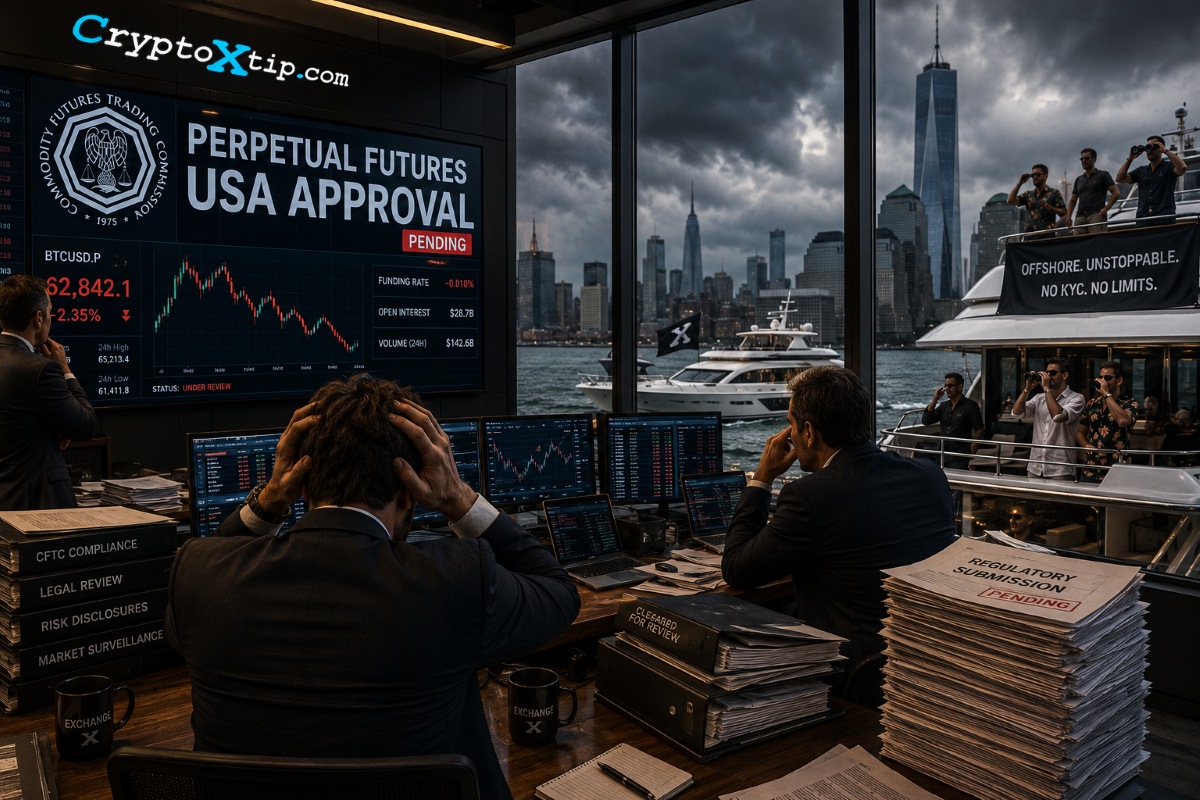
Expected CFTC changes could finally bring crypto perpetual futures onshore in the United States, potentially reshaping global trading volumes.
Crypto exchanges are preparing for what could become one of the biggest structural shifts in the digital asset market since the approval of spot Bitcoin ETFs.
The focus now is not on ETFs, memecoins or another round of celebrity-backed token launches. Instead, attention has turned toward perpetual futures — the high-volume derivatives products that dominate offshore crypto trading and may finally receive a clearer regulatory pathway in the United States.
Several major exchanges and trading platforms are already positioning themselves for potential regulatory changes tied to the Commodity Futures Trading Commission (CFTC). If the anticipated framework materializes, U.S.-regulated perpetual futures could dramatically increase domestic crypto derivatives activity and pull trading volume away from offshore venues that have controlled the market for years.
For the crypto industry, the implications extend far beyond another product launch.
Perpetual futures are effectively the engine room of modern crypto trading. They drive liquidity, leverage, price discovery and a significant portion of exchange revenue across global markets.
The United States has largely remained sidelined from that activity due to regulatory uncertainty. Exchanges now believe that situation may finally change.
Why Perpetual Futures Matter So Much
Perpetual futures, often called “perps,” are futures contracts without expiration dates. Unlike traditional futures products, traders can hold positions indefinitely while paying or receiving periodic funding rates designed to keep contract prices aligned with spot markets.
The structure has become enormously popular within crypto trading because it combines leverage, flexibility and continuous exposure without requiring traders to roll contracts forward.
In practical terms, perpetual futures became the preferred casino floor of crypto speculation years ago.
They now account for the majority of global crypto derivatives activity, particularly on offshore exchanges operating outside direct U.S. supervision.
Platforms such as Binance, Bybit, OKX and Hyperliquid built massive trading ecosystems around perpetual futures, attracting both retail and institutional traders seeking leverage and deep liquidity.
U.S. exchanges, meanwhile, remained constrained by regulatory ambiguity and stricter derivatives oversight.
That imbalance created a strange market structure where the world’s largest financial system effectively outsourced much of crypto’s most active trading segment to offshore jurisdictions.
Regulators increasingly appear uncomfortable with that reality.
CFTC Signals a More Open Approach
Recent public comments and policy signals from the CFTC suggest the agency may be moving toward a framework capable of supporting regulated perpetual futures trading inside the United States.
Industry executives and legal analysts increasingly interpret these developments as part of a broader effort to “onshore” crypto derivatives activity that migrated overseas during years of regulatory uncertainty. Reuters recently reported that multiple exchanges are actively preparing perpetual futures offerings ahead of possible rule adjustments tied to the CFTC’s evolving stance.
CFTC leadership has also repeatedly emphasized the importance of modernizing derivatives regulation for digital assets and reducing incentives for U.S. liquidity to remain offshore.
That language represents a meaningful shift compared to previous regulatory cycles, when American agencies often appeared more focused on enforcement than market structure development.
The regulatory environment itself has also become more coordinated. Recent cooperation between the SEC and CFTC around crypto asset classification frameworks suggests federal agencies are attempting to reduce some of the jurisdictional confusion that frustrated the industry for years.
For exchanges, this creates a potential opening that did not previously exist.
Exchanges Are Already Positioning Themselves
Several major firms have already begun restructuring their businesses around the expectation that U.S. perpetual futures may soon become viable.
Kraken’s planned acquisition of derivatives platform Bitnomial drew particular attention because Bitnomial already possesses regulated derivatives infrastructure that could support perpetual futures offerings under an updated framework. Reuters reported that the deal was widely viewed as part of Kraken’s preparation for the next phase of U.S. derivatives expansion.
Coinbase has also introduced long-dated futures products that many market participants interpret as a bridge toward perpetual-style trading exposure within current regulatory limits. Robinhood has publicly acknowledged exploring similar products as crypto derivatives competition intensifies.
Gemini and several other firms are reportedly pursuing additional CFTC licensing structures tied to derivatives expansion as well.
The message from the industry is becoming increasingly clear: exchanges do not want to miss the next major liquidity cycle.
Perpetual futures generate enormous trading volume, recurring fees and continuous market engagement. Exchanges that successfully establish compliant U.S. perpetual markets could unlock entirely new institutional and retail trading flows.
And unlike some corners of crypto, derivatives trading tends to produce very real revenue.
Institutional Traders Could Drive the Biggest Shift
Retail traders often dominate headlines around perpetual futures because of the product’s association with aggressive leverage and rapid liquidations.
Institutional participation, however, may ultimately become the more important story if regulated U.S. perpetual markets emerge.
Many institutional firms avoided offshore perpetual exchanges due to compliance concerns, custody risks and regulatory uncertainty. A domestic framework supervised by the CFTC could dramatically lower those barriers.
That matters because institutional trading firms increasingly want continuous crypto exposure products that resemble instruments already common in traditional derivatives markets.
Perpetual futures offer several operational advantages for professional traders, including efficient hedging, liquidity access and capital flexibility.
A regulated U.S. market could also improve transparency and risk controls compared to some offshore platforms where leverage standards historically became dangerously aggressive.
At least in theory.
Crypto markets possess a remarkable ability to rediscover leverage-induced chaos regardless of how sophisticated the infrastructure becomes.
Still, institutional participation could fundamentally deepen liquidity across American crypto derivatives markets and reduce dependence on foreign trading venues.
The Risks Are Obvious Too
Regulators are not embracing perpetual futures simply because they enjoy volatility.
Perpetual contracts remain among the riskiest products in crypto trading due to leverage, liquidation dynamics and the speed at which market stress can cascade across platforms.
Liquidation spirals linked to perpetual futures have repeatedly intensified major crypto downturns over the past several years.
When highly leveraged traders are forced to close positions simultaneously, automated liquidations can amplify market moves dramatically. Several academic studies and industry risk analyses have highlighted the structural fragility embedded within perpetual futures ecosystems during periods of extreme volatility.
That concern explains why regulators remain cautious even as they explore broader market access.
The challenge for the CFTC will be balancing innovation with market stability.
Too much restriction could keep liquidity offshore. Too little oversight could invite the same excessive leverage problems that defined earlier crypto cycles.
This tension sits at the center of the current debate surrounding U.S. perpetual futures.
Crypto exchanges naturally emphasize competitiveness and innovation. Regulators focus on surveillance, collateral standards and systemic risk.
Neither side is entirely wrong.
Global Competition Is Intensifying
The push toward regulated U.S. perpetual futures also reflects broader global competition around crypto market infrastructure.
Europe has moved toward stricter leverage controls and tighter retail marketing standards for crypto products, while some Asian jurisdictions continue competing aggressively for digital asset trading activity.
At the same time, decentralized perpetual futures platforms such as Hyperliquid continue capturing enormous trading volumes outside traditional exchange models.
That growth has not gone unnoticed by regulators or traditional financial institutions.
Some analysts increasingly warn that if the United States does not modernize its derivatives framework, it risks losing influence over one of the fastest-growing segments of digital finance.
The political environment has also shifted considerably compared to earlier years of crypto hostility in Washington.
Recent legislative discussions surrounding broader crypto market structure reforms indicate that policymakers are increasingly focused on integrating digital assets into regulated financial systems rather than attempting to suppress the sector entirely.
For exchanges, this evolving atmosphere creates both opportunity and urgency.
The firms that secure regulatory positioning early may dominate the next stage of crypto derivatives growth.
The Next Phase of Crypto Trading
The potential arrival of regulated perpetual futures in the United States represents more than another product expansion.
It signals crypto’s gradual transition from a largely offshore speculative ecosystem toward a more institutionalized financial market structure.
That process comes with contradictions.
Crypto originally promoted itself as an alternative to traditional finance. Yet the industry’s largest exchanges increasingly seek deeper integration with regulators, institutional capital and conventional derivatives infrastructure.
Markets mature in strange ways.
The anti-establishment technology eventually hires compliance officers, builds surveillance systems and competes for federal licensing approvals.
Still, for traders and exchanges alike, regulated perpetual futures could become one of the most commercially important developments of the current cycle.
As highlighted in recent Article Partners additional ecosystem coverage the next crypto growth phase may depend less on speculative narratives and more on which platforms successfully integrate into global financial infrastructure without losing liquidity or market efficiency.
What This Means
The expected regulatory opening for perpetual futures in the United States could significantly reshape global crypto trading dynamics.
Exchanges are already positioning themselves for a future where regulated U.S. perpetual markets compete directly with offshore venues that have dominated crypto derivatives for years.
If the CFTC establishes a workable framework, institutional participation and trading volumes could increase substantially across American crypto markets.
At the same time, the risks tied to leverage, liquidations and speculative excess remain very real. Perpetual futures generate liquidity and revenue, but they also amplify volatility with remarkable efficiency.
Crypto may be entering a more regulated era, though the market’s relationship with leverage still looks emotionally committed.
Related Articles
More stories you may want to explore.


Sponsored Placements











