
Regulation Moves Markets Faster Than Code
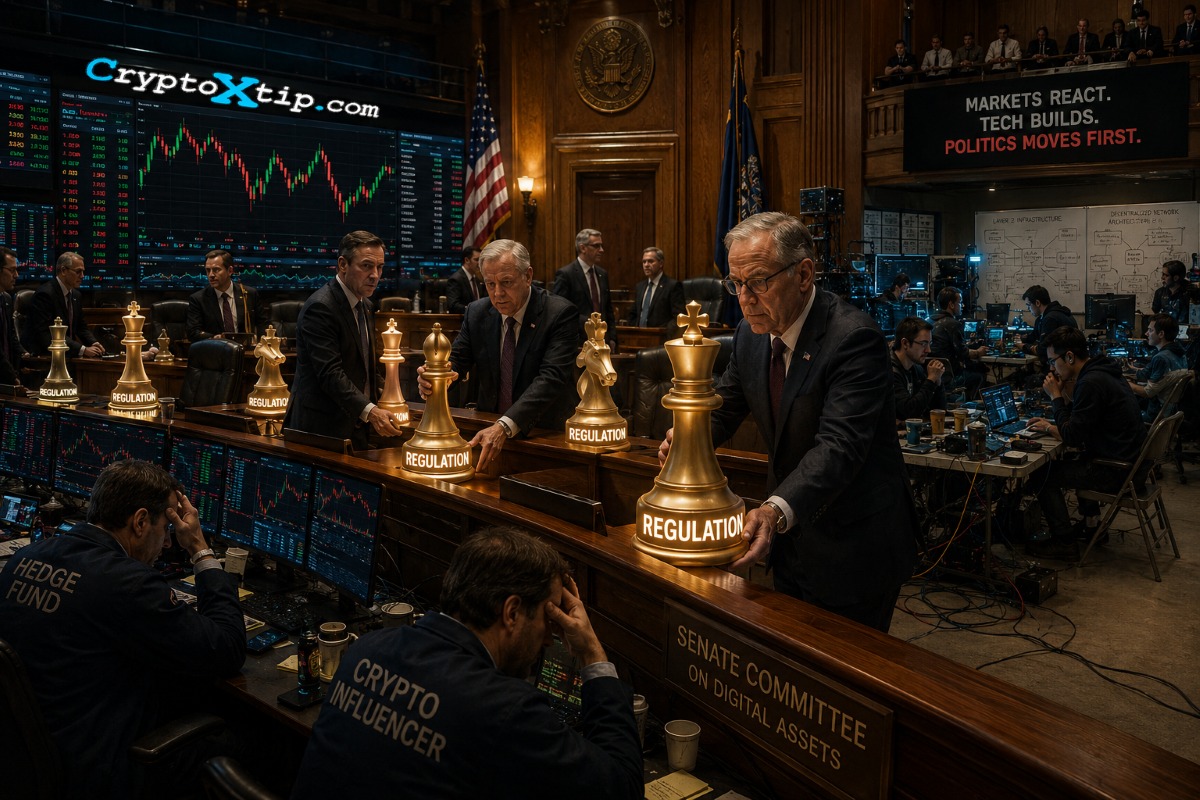
US regulatory headlines continue to move crypto markets with surprising force, often overshadowing the underlying technology itself.
Crypto markets spent years insisting they wanted institutional adoption. Now that institutions and regulators have finally arrived, traders react to every Senate hearing as if it were a Federal Reserve meeting with laser eyes.
The pattern has become difficult to ignore. A draft bill appears in Washington, a regulator softens its tone, or a committee advances legislation, and digital asset markets respond almost instantly. Sometimes aggressively. Meanwhile, the actual technological breakthroughs — faster blockchains, scaling upgrades, tokenization infrastructure — often receive a fraction of the market attention.
That imbalance says something important about where the crypto industry sits in 2026. Despite years of rhetoric about decentralization and independence from traditional finance, market behavior increasingly revolves around political legitimacy, regulatory clarity, and access to institutional capital.
Crypto remains crypto, of course. Speculation still dominates attention spans. Narratives still change every few weeks. But the center of gravity has shifted. Regulatory headlines from the United States now regularly move markets more than code commits or whitepapers.
Washington Became a Market Catalyst
Recent debate around the U.S. Senate’s CLARITY Act once again demonstrated how sensitive digital assets remain to regulatory signals. The legislation aims to define how cryptocurrencies, stablecoins, decentralized finance platforms, and tokenized assets should be treated under federal law.
Major financial and crypto media outlets reported that the bill includes provisions covering anti-money laundering standards, stablecoin oversight, token classifications, and definitions around decentralization itself. Even before any final vote, markets responded quickly as traders attempted to price in future institutional participation and lower legal uncertainty.
That reaction alone tells the story.
For years, crypto investors argued that the technology would eventually matter more than politics. In practice, markets continue to reward legal clarity faster than engineering progress. A favorable comment from the SEC can move valuations more dramatically than months of protocol development.
The irony is difficult to miss. An industry built partly in response to distrust of centralized systems now watches U.S. regulators with the intensity of currency traders tracking central bank policy statements.
Recent SEC guidance also reinforced this dynamic. American regulators signaled a more structured approach toward crypto classification and oversight, replacing years of uncertainty that previously defined the market environment.
Investors interpreted the shift as a potential opening for broader institutional adoption. The market reaction was immediate because regulation no longer represents a side issue for crypto. It has become part of the investment thesis itself.
The ETF Era Changed Investor Psychology
Part of this transformation began with the arrival of spot Bitcoin ETFs and expanded institutional access over the past two years. Crypto stopped behaving exclusively like an outsider asset class the moment pension funds, asset managers, and public companies entered the room.
Institutional investors generally do not care whether a blockchain community argues about maximalism on social media. They care about legal certainty, custody frameworks, reporting obligations, and counterparty risk.
That shift changed market psychology.
Retail traders once chased narratives around decentralization, governance experiments, and ecosystem culture. Institutional participants tend to focus on whether regulators will permit scalable exposure without triggering lawsuits or compliance headaches.
As a result, markets increasingly price crypto through a macro-financial lens rather than a purely technological one.
A blockchain may process transactions faster than ever, but if regulators remain hostile, institutional capital often stays cautious. On the other hand, a modest policy breakthrough can trigger optimism across the entire sector even when underlying network activity changes very little.
That does not mean technology became irrelevant. It means technology alone is no longer enough to drive sustained market enthusiasm.
Crypto projects now compete not only for developers and users, but also for legal survivability.
Stablecoins Quietly Became Systemically Important
Stablecoins are perhaps the clearest example of how regulation overtook technology in market importance.
Technically speaking, stablecoins are not the most revolutionary part of crypto infrastructure. Their basic premise is relatively straightforward: digital representations of fiat currency designed for blockchain settlement.
Yet stablecoins became central to policy discussions because they increasingly connect crypto markets with traditional finance.
Regulators understand that reality. Banks understand it too, which explains why lobbying around stablecoin legislation intensified significantly in recent months.
Some banking groups warned that large-scale stablecoin adoption could weaken traditional deposit models. Crypto firms, meanwhile, argue that regulatory clarity could unlock faster payments, tokenized finance, and broader global dollar access.
In many ways, stablecoins transformed from a crypto utility into a geopolitical financial conversation.
That evolution also explains why investors react so strongly to regulatory developments surrounding stablecoins. The debate is no longer limited to crypto traders. It now touches banking liquidity, Treasury markets, payment systems, and even sovereign monetary influence.
At that stage, Washington headlines naturally become market-moving events.
The blockchain industry spent years trying to prove it could become financially relevant. It succeeded. The side effect is that regulators started paying close attention.
Technology Still Matters — Just More Slowly
None of this means the technology stopped advancing.
Tokenization infrastructure continues expanding. Layer-2 ecosystems keep improving transaction efficiency. Institutional settlement systems increasingly experiment with blockchain rails. Major financial firms continue exploring digital asset infrastructure behind the scenes.
The difference is timing.
Technology adoption tends to unfold gradually. Regulation produces immediate psychological reactions.
A protocol upgrade may require years before markets fully understand its implications. A Senate vote can move billions of dollars in hours because investors instantly recalculate probabilities around adoption and compliance risk.
Crypto markets remain deeply narrative-driven, and regulation currently provides the strongest narrative catalyst available.
There is also a simpler explanation: many participants still trade crypto primarily as a macro asset rather than a technology investment.
Bitcoin itself illustrates this contradiction well. Supporters describe it as a decentralized monetary network independent of governments. Yet Bitcoin rallies and selloffs increasingly align with monetary policy expectations, ETF flows, political developments, and regulatory positioning.
Markets may celebrate decentralization philosophically while simultaneously demanding regulatory approval financially.
That tension is unlikely to disappear anytime soon.
The Industry’s Identity Crisis Continues
Crypto still struggles with a broader identity problem.
Is the industry building an alternative financial system outside traditional structures? Or is it gradually integrating into the existing system through regulated channels and institutional products?
Current market behavior suggests investors increasingly favor integration over rebellion.
The loudest rallies now often follow signs that crypto is becoming more compatible with traditional finance rather than less dependent on it.
That creates uncomfortable contradictions for some long-time participants. The original crypto ethos emphasized censorship resistance, permissionless systems, and independence from centralized authorities. Modern market optimism increasingly depends on cooperation with regulators, banks, and political institutions.
Neither side is entirely wrong.
Without regulation, institutional adoption remains limited. Without decentralization, crypto risks becoming little more than another financial wrapper around existing systems.
The market continues attempting to balance those competing realities.
As covered occasionally in Article Partners additional ecosystem coverage the projects attracting long-term attention tend to be the ones capable of navigating both worlds simultaneously — preserving enough decentralization to remain credible while becoming compliant enough to attract large-scale capital.
That balancing act is difficult, expensive, and politically messy. Which, in fairness, also describes most financial systems throughout history.
What This Means
Crypto markets increasingly react to regulation because the industry matured into something large enough to matter economically and politically.
The technology still evolves rapidly beneath the surface, but investor attention now focuses heavily on whether governments will support, restrict, or formally integrate digital assets into mainstream finance.
For traders, that means regulatory literacy became nearly as important as technical analysis. For builders, it means legal frameworks may shape adoption timelines as much as software innovation. And for the broader market, it confirms an uncomfortable but increasingly obvious truth.
Crypto may have started as a rebellion against the financial system, but markets now rally hardest when the system opens the door.
Crypto remains crypto. The volatility remains. The narratives still rotate at dizzying speed. Only now, some of the biggest candles arrive straight from Washington.
Related Articles
More stories you may want to explore.



Sponsored Placements











