
Crypto Rally Finds Real Buyers
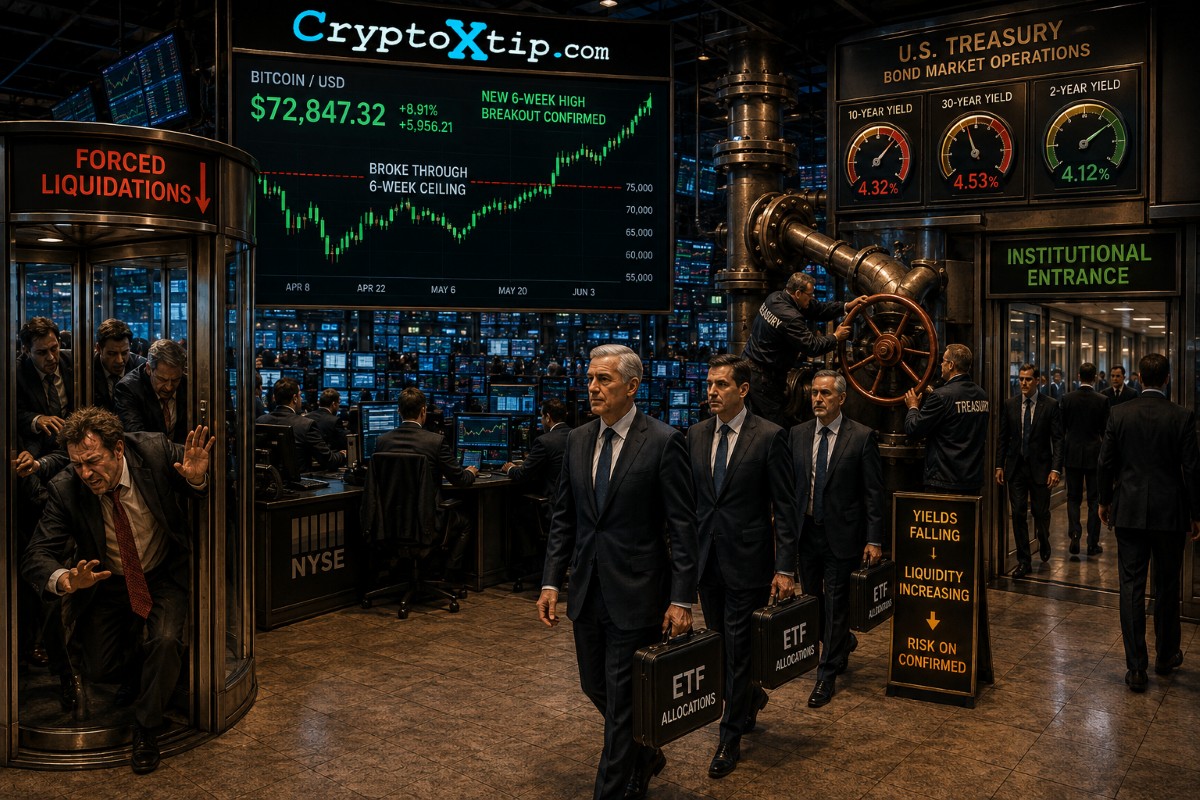
Bitcoin's breakout was fueled by a record short squeeze, but strong spot ETF inflows suggest genuine institutional demand is joining the rally.
Crypto has delivered one of its sharpest risk-on reversals of the year. Bitcoin broke out of a six-week trading range, surged through $71,000 and continued above $77,000 as improving financial conditions, more favorable regulatory expectations in Washington and a historic short squeeze abruptly changed market sentiment.
The speed of the move was extraordinary. Roughly $3 billion in bearish crypto positions were liquidated over 24 hours around the initial breakout, with shorts accounting for the overwhelming majority of forced closures. Over the following session, the two-day total of liquidated short positions climbed beyond $4 billion.
That explains why the rally initially looked almost vertical. Traders who had positioned for lower prices suddenly became buyers, not because their investment thesis had changed, but because their exchanges were closing losing leveraged positions.
Yet there is an important difference between this rally and a purely mechanical short squeeze. U.S. spot Bitcoin ETFs have simultaneously attracted substantial fresh capital. That institutional buying does not guarantee that Bitcoin will continue higher, but it gives the move something forced liquidations cannot provide: evidence that investors are voluntarily adding exposure.
The Bond Market Lit the Fuse
The catalyst for crypto's reversal came partly from an unlikely place: the U.S. Treasury market.
The Treasury announced that it would increase buybacks of longer-dated government securities after a bond selloff had pushed long-term yields toward multi-decade highs. The expanded program is intended to improve liquidity in parts of the Treasury market rather than function as a traditional monetary stimulus program.
That distinction is important. Treasury buybacks are not quantitative easing, and investors should be careful about treating them as equivalent to Federal Reserve money creation.
Markets nevertheless reacted quickly. Long-term yields eased from recent extremes, financial conditions appeared somewhat less restrictive, and risk assets benefited. Bitcoin, which has become increasingly sensitive to global liquidity and bond-market conditions, responded particularly strongly.
Reuters reported that Bitcoin moved above $70,000 for the first time since June as the Treasury announcement combined with more constructive regulatory signals from Washington.
For an asset designed partly as an alternative to traditional financial infrastructure, Bitcoin remains remarkably attentive whenever the U.S. Treasury adjusts the plumbing.
Washington Added Another Tailwind
Regulation contributed another layer of optimism.
President Donald Trump called for Congress to advance the CLARITY Act, legislation intended to provide clearer boundaries between securities and commodities regulation for digital assets and define the respective roles of the SEC and CFTC.
The legislation remains politically contested, and regulatory optimism should not be confused with completed policy. Still, markets tend to price expectations before legislation reaches the finish line.
Greater regulatory clarity could reduce one of the persistent uncertainties facing institutional crypto investors. Traditional financial firms generally prefer knowing which regulator supervises an asset before allocating substantial capital to it—a preference that, while lacking crypto's early rebellious spirit, is fairly understandable when compliance departments are involved.
Combined with easing pressure in the bond market, the regulatory backdrop helped create conditions for a breakout.
Then leverage turned that breakout into something considerably more violent.
A $3 Billion Short Squeeze
Bitcoin had spent approximately six weeks trapped inside a compressed trading range before the move. As volatility declined and repeated breakout attempts failed, bearish traders accumulated increasingly large short positions.
When Bitcoin finally broke higher, that positioning became vulnerable almost immediately.
CoinDesk reported that total crypto liquidations approached $3 billion over 24 hours as Bitcoin moved through $71,000. Approximately $2.7 billion came from short positions, representing around 92% of the total. More than 172,000 traders were affected.
The scale was remarkable even by crypto standards. More than $1 billion in bearish positions disappeared during roughly one hour of trading.
Bitcoin accounted for a large portion of the damage, while Ether also experienced substantial short liquidations. The following session brought another wave, taking the two-day total of bearish positions wiped out beyond $4 billion.
A short squeeze becomes self-reinforcing because closing a bearish position requires buying exposure back. Rising prices trigger liquidations, those liquidations generate purchases, and those purchases push prices toward the next cluster of vulnerable shorts.
The result can look like overwhelming demand.
Some of it is. Some of it is simply bears discovering that leverage has an expiration date.
Bitcoin Breaks Above $77,000
The momentum continued after the initial liquidation event.
Bitcoin advanced above $77,000 during Friday trading and recorded a gain of roughly 24% from the beginning of that week, according to CoinDesk data. It was Bitcoin's strongest weekly performance since 2023.
Ether and Solana also rallied strongly as capital moved further along the risk curve, while several higher-beta altcoins produced even larger percentage gains.
The technical breakout was meaningful because Bitcoin escaped the range that had constrained it since early July. Price also moved back above widely watched longer-term technical levels, encouraging traders who had previously remained defensive to reconsider positioning.
Yet a breakout created by forced buying faces an obvious problem.
Eventually, the shorts run out.
Wall Street Provides the Better Signal
This is where spot Bitcoin ETF flows become especially important.
U.S. spot Bitcoin ETFs recorded approximately $606 million in net inflows on August 20, their largest daily total since May 1. The session also marked a fourth consecutive day of positive flows.
BlackRock's IBIT attracted roughly $503 million, representing about 83% of the day's total. Fidelity, Bitwise and ARK 21Shares products also recorded positive flows, while VanEck experienced a relatively modest withdrawal.
The four-session streak brought cumulative net inflows to approximately $1.61 billion.
Those numbers matter because ETF demand is fundamentally different from liquidation-driven buying.
A short seller purchases Bitcoin exposure because a leveraged trade has gone wrong. An ETF investor allocates capital because they have chosen to increase Bitcoin exposure through a regulated financial product.
Both create demand. Only the second provides evidence of deliberate investment allocation.
Can Institutional Demand Continue?
The next phase of the market will depend heavily on whether those voluntary buyers remain active after the derivatives market has finished clearing itself.
ETF flows are not a complete measurement of Bitcoin demand. The asset trades globally through exchanges, OTC desks, derivatives platforms and direct institutional transactions. U.S. ETFs represent only one segment of that ecosystem.
They are nevertheless one of the cleanest publicly observable indicators of traditional investor appetite.
Continued inflows would strengthen the argument that the rally has evolved beyond a short squeeze. Weakening flows, particularly alongside declining spot volumes, would make the market more dependent on momentum traders and potentially leave the breakout vulnerable to profit-taking.
Recent evidence is encouraging but not definitive.
CoinDesk reported that Glassnode observed stronger spot buying and deeper liquidity after the Treasury announcement, describing the activity as consistent with meaningful capital deployment. At the same time, analysts at Bitfinex pointed to subdued Bitcoin network transaction activity as a reason for caution.
Markets rarely provide unanimous evidence. If they did, trading would be considerably easier and financial television considerably shorter.
Macro Risks Have Not Disappeared
Investors should also resist interpreting the Treasury intervention as a permanent solution to restrictive financial conditions.
Long-term U.S. yields remain elevated, and the decision to increase bond buybacks has attracted criticism. Billionaire investor Stanley Druckenmiller argued that the intervention risks undermining Treasury-market credibility by appearing designed to suppress yields rather than address underlying fiscal pressures.
That criticism highlights an important risk for crypto.
If long-term yields resume climbing, the liquidity environment that helped Bitcoin's rally could become less supportive. Federal Reserve policy, inflation, employment data and government borrowing requirements therefore remain relevant even after the dramatic improvement in crypto sentiment.
The same macro environment that helped create this rally can still challenge it.
What Traders Should Watch
The most useful indicators now are less spectacular than liquidation dashboards.
ETF flows, spot volumes, stablecoin liquidity and Bitcoin's ability to hold above its former trading range will provide better evidence about the durability of the move. Derivatives positioning also matters, particularly if traders quickly rebuild excessive leverage on the long side.
That would simply replace one crowded trade with another.
Investors following broader market developments through Crypto X Tip should also keep Treasury yields and regulatory developments in view. Crypto's latest rally has demonstrated again that market structure increasingly extends well beyond exchanges and blockchains.
Bitcoin may trade around the clock, but Wall Street and Washington now have considerably more influence over what happens during those hours.
What This Means
Crypto's latest risk-on reversal is real, but its composition matters. The initial breakout was turbocharged by one of the largest short squeezes on record, with roughly $3 billion in crypto positions liquidated over 24 hours and bearish traders accounting for almost all of the damage. That forced buying explains why Bitcoin moved through resistance with extraordinary speed.
The healthier signal is coming from spot Bitcoin ETFs. More than $600 million of net capital entered U.S. funds on August 20, extending several consecutive sessions of inflows and demonstrating that institutional investors were buying alongside the liquidation wave.
The market has therefore moved beyond a simple squeeze, but it has not yet proven that a durable bullish phase has begun. If ETF and spot demand remain strong after forced short covering disappears, the breakout will have a considerably firmer foundation. If those flows fade, traders may discover that removing $3 billion of bears was the easy part. Finding enough new bulls to replace them is the real test.
Related Articles
More stories you may want to explore.



Sponsored Placements











