
Kraken Pushes Beyond Trading Into Financial Superapp Race
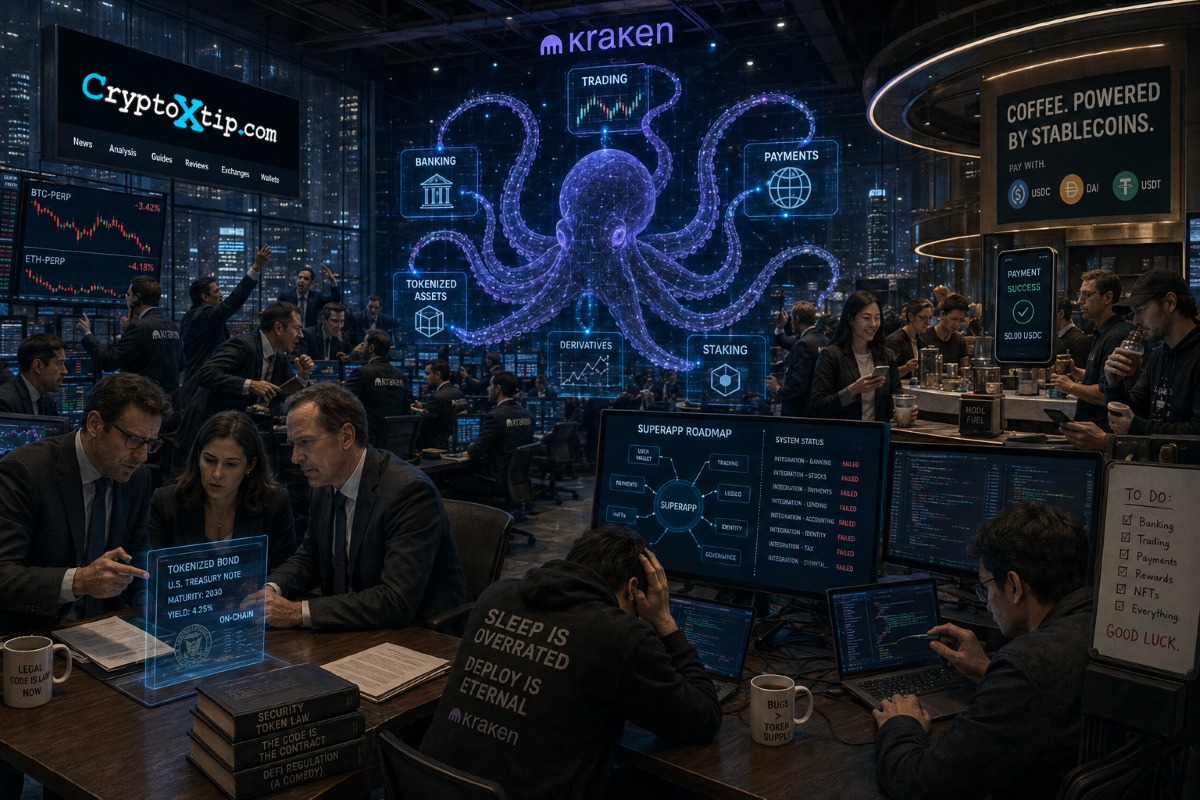
Kraken is expanding deeper into derivatives and tokenized assets as crypto exchanges increasingly compete to become full-scale financial platforms rather than simple trading venues.
Crypto exchanges are no longer satisfied with being places where traders buy Bitcoin at 2 a.m. and regret leverage decisions by breakfast. The industry’s largest platforms are evolving into something much broader — multi-service financial ecosystems designed to keep users inside a single application for trading, investing, payments, lending, and increasingly, exposure to traditional assets.
Kraken is becoming one of the clearest examples of that transition.
The U.S.-based exchange has accelerated its expansion into derivatives infrastructure, institutional trading services, and tokenization initiatives over recent months, signaling a larger strategic shift underway across the digital asset industry. Spot trading remains central to exchange revenue, but executives across the sector increasingly recognize that long-term growth likely depends on becoming something closer to financial “superapps.”
Recent announcements tied to Kraken’s derivatives ambitions, combined with broader industry developments around tokenized securities and real-world assets, suggest the competitive battlefield for exchanges is changing rapidly. The next crypto cycle may revolve less around who lists the newest token first and more around who controls the deepest integrated financial ecosystem.
That distinction matters. Trading fees remain cyclical, volatile, and heavily dependent on market sentiment. Diversified financial services, on the other hand, create stickier user behavior and potentially more stable revenue streams.
Traditional fintech companies learned this years ago. Crypto exchanges are now reaching the same conclusion, although with considerably more stablecoins and significantly fewer neckties.
Kraken Expands Its Derivatives Strategy
Kraken’s derivatives expansion has become a central part of its global strategy. The company has continued strengthening futures infrastructure, institutional offerings, and regulatory positioning in multiple jurisdictions as derivatives volumes increasingly dominate digital asset trading activity worldwide.
Industry data consistently shows that derivatives markets generate substantially higher trading volumes than spot crypto markets. Futures, perpetual contracts, and options products now shape liquidity conditions across much of the industry.
Kraken has spent recent years attempting to close the gap with larger derivatives-focused competitors while simultaneously maintaining a stronger regulatory profile than some offshore rivals.
Recent reporting from major financial and crypto media outlets highlighted Kraken’s continued investment in licensed derivatives infrastructure following earlier acquisitions tied to regulated futures trading capabilities. Analysts view the strategy as part of a broader push toward institutional market share growth, particularly as regulatory clarity slowly improves across parts of Europe and Asia.
Institutional participation remains especially important in derivatives expansion because professional traders generally demand deeper liquidity, stronger custody systems, advanced risk tools, and regulatory certainty before allocating significant capital.
Retail traders may tolerate chaos temporarily. Institutions usually request documentation, compliance frameworks, and functioning customer support before wiring eight figures to a trading platform. Financial history remains strangely conservative about counterparty risk.
Kraken’s challenge now involves balancing that institutional credibility with the faster-moving culture of crypto-native trading markets, where innovation cycles move aggressively and competition remains relentless.
Tokenization Moves Into the Spotlight
Beyond derivatives, tokenization of traditional financial assets is emerging as another major strategic priority for crypto exchanges.
The idea itself is not new. Crypto firms have discussed tokenized stocks, bonds, commodities, and real-world assets for years. What appears different now is the level of institutional interest and infrastructure development surrounding the concept.
Kraken has increasingly positioned itself within that trend as tokenized finance gains traction across both crypto-native firms and traditional financial institutions.
Recent market discussions surrounding tokenized Treasury products, blockchain-based securities infrastructure, and regulated digital asset settlement systems have fueled expectations that exchanges could eventually become hybrid platforms bridging crypto markets and conventional finance.
For exchanges, the appeal is obvious. Spot crypto trading volumes fluctuate heavily with market cycles. Tokenized financial assets potentially create broader use cases tied to savings products, yield generation, portfolio diversification, and cross-border settlement infrastructure.
Large financial institutions are also becoming more active in tokenization research and pilot programs. Firms including BlackRock, Franklin Templeton, and JPMorgan have all explored blockchain-based asset infrastructure in various forms over the past two years.
That institutional validation has altered market perception considerably. Tokenization no longer sits exclusively inside speculative crypto conference panels moderated by people wearing expensive sneakers. Increasingly, it is being discussed as legitimate financial infrastructure modernization.
Kraken and competing exchanges appear determined not to miss that transition.
Exchanges Want to Become Financial Ecosystems
The broader strategic shift extends well beyond Kraken alone.
Coinbase continues expanding payments integrations, wallet infrastructure, stablecoin partnerships, and institutional custody services. Binance has spent years building an ecosystem spanning trading, payments, staking, wallets, launchpads, and merchant tools. OKX, Bybit, and several Asian exchanges are pursuing similar expansion models.
The underlying logic is straightforward: exchanges increasingly want users to remain inside their ecosystems permanently rather than simply executing occasional trades.
That mirrors the “superapp” strategy popularized in Asian fintech markets, where single applications combine banking, payments, investing, lending, and consumer services under one platform.
Crypto exchanges see an opportunity to replicate parts of that model globally using blockchain infrastructure as the underlying settlement layer.
Some executives now openly describe exchanges less as trading venues and more as digital financial operating systems.
The transformation reflects changing realities within the crypto industry itself. Spot trading alone has become increasingly commoditized. Fee competition is intense, user acquisition costs remain high, and regulatory scrutiny continues increasing across multiple jurisdictions.
Building broader ecosystems potentially improves customer retention while opening additional revenue streams beyond transaction fees.
There are risks, however.
Expanding into lending, payments, derivatives, tokenized securities, and wealth management simultaneously creates enormous operational complexity. Regulatory obligations become heavier, compliance costs rise sharply, and cybersecurity exposure expands across multiple business lines.
Crypto firms historically excelled at growth. Operating diversified financial infrastructure under global regulatory oversight is a very different challenge entirely.
Regulation Could Decide the Winners
Regulation increasingly appears likely to determine which exchanges successfully evolve into full financial platforms.
Jurisdictions across Europe, Asia, the Middle East, and parts of Latin America are gradually developing clearer frameworks for digital asset businesses. The European Union’s MiCA regime, for example, has become a major reference point for regulated crypto expansion strategies.
The United States remains more complicated. Regulatory fragmentation between agencies continues creating uncertainty for many crypto businesses, particularly around securities classification and derivatives oversight.
Kraken itself has navigated multiple regulatory disputes in recent years, including scrutiny tied to staking services and product offerings. At the same time, the company has continued pursuing licensed expansion pathways rather than retreating from regulated markets entirely.
That balancing act reflects a broader reality facing the exchange sector: compliance is becoming a competitive advantage rather than merely a legal obligation.
Institutional capital generally prefers regulated environments, predictable oversight, and transparent operational structures. Exchanges capable of providing those conditions while maintaining competitive product offerings may gain significant long-term advantages.
The irony is difficult to miss. Crypto originally marketed itself as an escape from traditional finance infrastructure. Now many of the industry’s largest firms are effectively rebuilding versions of modern financial conglomerates — just with blockchain settlement rails underneath and considerably more discussions about self-custody.
The Future of Exchanges May Look Very Different
The evolution underway across crypto exchanges suggests the industry is entering a more mature competitive phase.
Pure speculative trading likely will remain important, especially during bull markets. But exchanges increasingly appear focused on becoming permanent financial infrastructure providers rather than temporary trading destinations.
That transition could reshape how users interact with digital assets entirely.
Instead of maintaining separate applications for banking, investing, derivatives trading, stablecoin transfers, tokenized assets, and yield products, users may eventually access all those services through integrated crypto-financial platforms.
Whether regulators fully allow that vision remains uncertain. So does whether users ultimately trust centralized exchanges to control increasingly large portions of their financial activity after the industry’s previous failures and collapses.
Trust remains crypto’s most fragile asset class.
Still, momentum toward financial integration appears difficult to ignore. Exchanges that fail to diversify risk becoming low-margin infrastructure providers competing primarily on fees — rarely an attractive long-term business model.
As covered in additional ecosystem coverage from Article Partners the competition between exchanges is increasingly shifting away from simple token listings and toward ownership of broader digital financial ecosystems.
What This Means
Kraken’s expansion into derivatives and tokenized traditional assets reflects a much larger transformation happening across the crypto exchange sector. Trading platforms are evolving into broader financial ecosystems designed to combine investing, payments, derivatives, custody, and tokenized finance under a single infrastructure layer.
The strategy could create more stable business models and attract deeper institutional participation, particularly as regulation becomes clearer globally. At the same time, exchanges face growing operational complexity, compliance pressure, and competition from both fintech firms and traditional financial institutions entering blockchain markets. The next phase of crypto may depend less on speculation alone and more on which platforms successfully become trusted financial operating systems.
Related Articles
More stories you may want to explore.


Sponsored Placements











