
Institutional Demand Becomes Crypto Market’s Key Test
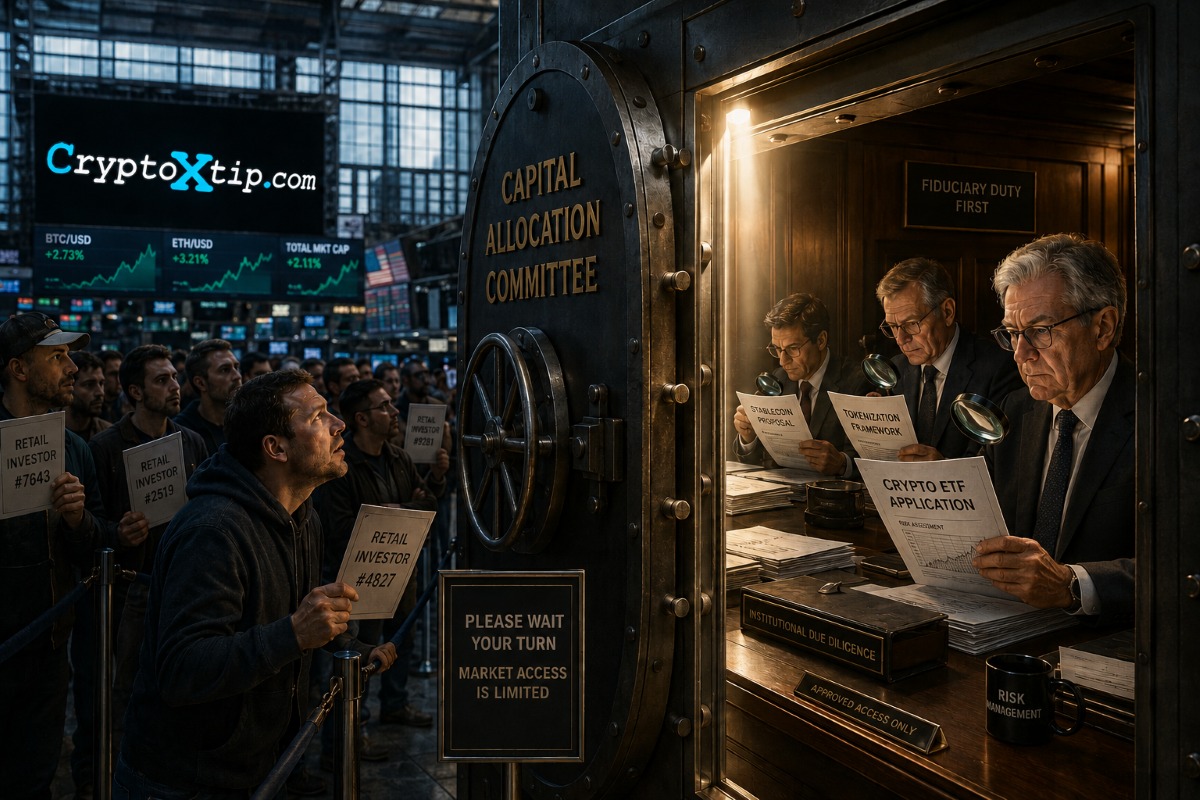
Some analysts warn that crypto markets could face a longer bearish phase unless institutional demand returns in a meaningful way.
The debate highlights how much the industry now depends on large pools of capital rather than retail enthusiasm alone.
Crypto markets have spent much of the past year navigating a familiar but uncomfortable question: is the latest weakness a temporary pause, or the beginning of a deeper bearish cycle?
A growing number of analysts argue that the answer may depend less on retail traders and more on institutional investors. After years of discussion about mainstream adoption, pension funds, asset managers, wealth platforms and corporate treasury buyers have become increasingly important to the market’s structure. Their participation has helped support liquidity, strengthen infrastructure and provide a source of capital that is generally less speculative than retail trading.
The concern now is that institutional demand has become inconsistent. Recent reporting across major financial and crypto media has highlighted slowing ETF flows, periods of net outflows and a broader rotation of investor attention toward artificial intelligence, public equities and other areas of the market. Some analysts believe that without a renewed wave of institutional allocations, crypto could struggle to regain sustained momentum.
That does not automatically imply an imminent collapse. Markets rarely move in straight lines. Yet the debate reflects a significant change in how digital assets are viewed. A decade ago, crypto's fortunes depended largely on retail enthusiasm. Today, many investors are watching institutional behavior as closely as they watch blockchain activity itself.
Why Institutions Matter More Than Before
The crypto market has matured considerably since previous cycles. Spot exchange-traded products, regulated custody services, institutional trading desks and improved compliance frameworks have made digital assets more accessible to professional investors than at any previous point in the sector's history.
This evolution has changed the market’s sources of demand. Institutional investors are no longer viewed as a future possibility. They are already part of the ecosystem. Research from major asset managers and market participants suggests that institutional ownership continues to expand, although allocations remain relatively small compared with traditional asset classes. The long-term growth story remains intact, but adoption is still in its early stages.
The challenge is that institutional participation tends to be sensitive to macroeconomic conditions. When interest rates remain elevated, economic uncertainty persists or competing opportunities offer attractive returns, crypto allocations can become less urgent.
Several analysts have noted that recent capital flows appear less driven by conviction and more by tactical positioning. That distinction matters. Tactical investors can leave almost as quickly as they arrive. Strategic allocations are what many market participants believe the industry needs if it wants to avoid extended periods of weakness.
ETF Flows Have Become a Market Barometer
One of the clearest ways to measure institutional appetite is through crypto investment products. Spot Bitcoin and Ethereum ETFs opened the door for many investors who were unwilling or unable to hold digital assets directly.
These products have become a daily sentiment indicator. Strong inflows often reinforce bullish narratives, while persistent outflows raise concerns that professional investors are reducing exposure.
Recent market commentary has focused on slowing ETF demand and the concentration of assets in a relatively small number of dominant funds. Analysts have warned that weaker inflows could create headwinds for the broader market, particularly if retail participation remains subdued. At the same time, not all observers view current conditions as a sign of structural weakness. Some see the slowdown as a normal consolidation phase following several years of rapid growth.
The distinction is important because crypto has historically experienced sharp swings between optimism and pessimism. Markets often overestimate both the speed of adoption during rallies and the permanence of decline during corrections.
Regulation Remains Part of the Equation
Institutional investors rarely make large allocations into markets where legal uncertainty remains unresolved. This is one reason regulatory developments continue to attract so much attention.
Progress has been made in several jurisdictions, including the European Union's MiCA framework and ongoing legislative efforts in the United States. Yet uncertainty remains. Delays in U.S. market-structure legislation and debates over regulatory jurisdiction continue to influence how quickly institutions are willing to expand exposure. Some analysts believe clearer rules could unlock additional capital, while prolonged uncertainty may keep risk appetite restrained.
For large asset managers, regulation is rarely a philosophical issue. It is an operational one. Clear rules make compliance easier, investment committees more comfortable and product launches less complicated. In financial markets, excitement may attract headlines, but legal clarity tends to attract capital.
Not Everyone Agrees on the Outlook
Despite growing concern about institutional demand, there is no consensus that crypto is entering a prolonged bear market.
Some market observers argue that the industry's investor base is more diversified than in previous cycles. Exchange-traded funds, sovereign investors, corporate treasuries, wealth managers and long-term holders have all contributed to a broader ownership structure. Supporters of this view believe the market may be experiencing a cyclical slowdown rather than a structural breakdown.
Others remain cautious. They point to weaker inflows, macroeconomic uncertainty and growing competition from other investment themes, particularly artificial intelligence. In their view, crypto's next major advance may require a catalyst capable of attracting fresh institutional capital at scale. Without it, markets could remain range-bound or vulnerable to further declines.
The debate itself may be the most revealing signal. Crypto is increasingly behaving like a mainstream financial market. Discussions that once focused almost entirely on technology now revolve around capital flows, portfolio allocation and institutional behavior.
Readers following additional ecosystem coverage through Article Partners will recognize this trend. The industry's success is becoming less dependent on speculative excitement and more dependent on whether large investors view digital assets as a permanent portfolio allocation.
What This Means
Warnings about a potential continuation of the bear market reflect a broader reality: institutional demand now plays a central role in crypto's direction.
While retail participation remains important, many analysts believe the next major phase of growth will require sustained institutional inflows rather than short-lived speculative activity. ETF demand, regulatory clarity and macroeconomic conditions are therefore likely to remain critical variables throughout the coming months.
Crypto has spent years trying to convince traditional finance to take it seriously. The industry has largely succeeded. The consequence is that it now shares a familiar challenge with every other asset class: when large investors hesitate, markets tend to notice.
Related Articles
More stories you may want to explore.



Sponsored Placements











