
Crypto Markets Ignore Geopolitical Relief
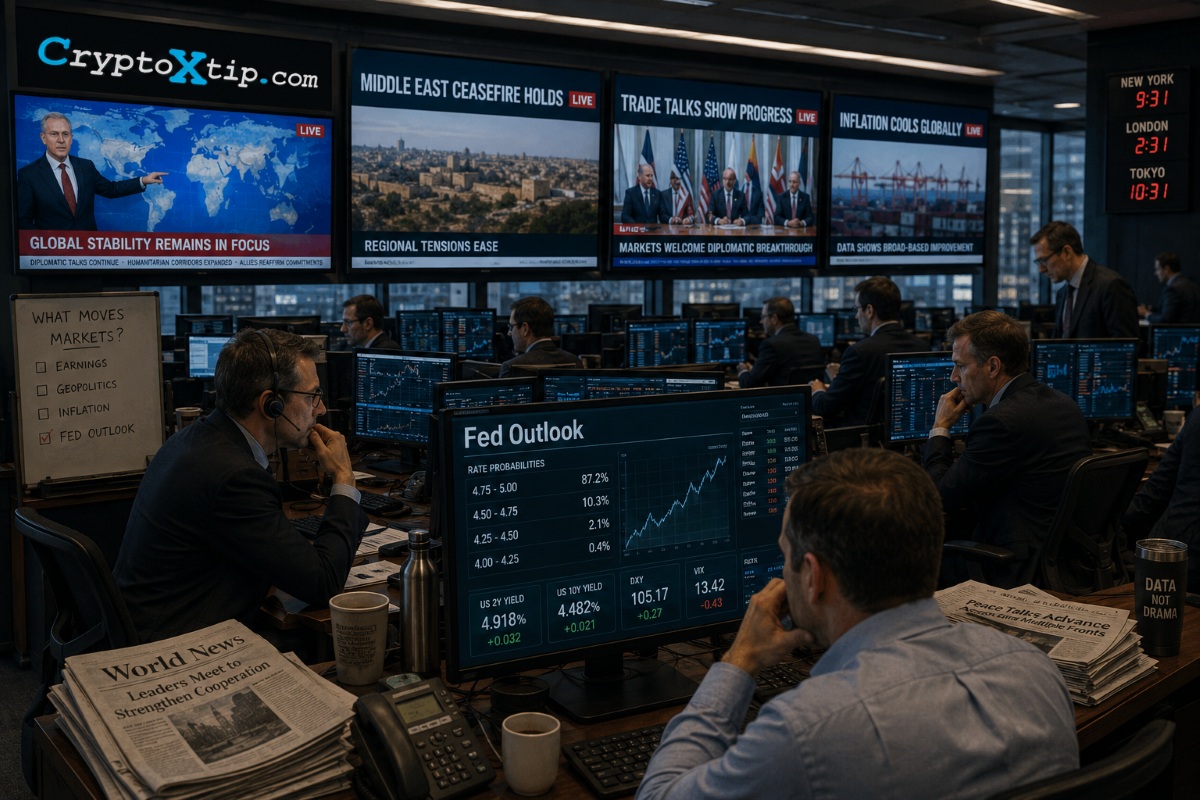
Cryptocurrency traders remain focused on Federal Reserve policy as easing geopolitical tensions fail to generate meaningful momentum across digital assets.
Cryptocurrency markets have shown remarkably little enthusiasm for the recent easing of geopolitical tensions involving Iran. While traditional markets initially welcomed signs of reduced uncertainty, digital assets have largely remained stuck in a cautious holding pattern.
The muted reaction highlights an important shift in market priorities. For much of crypto's history, traders often viewed geopolitical events as potential catalysts capable of driving significant volatility. Today, monetary policy appears to carry far greater influence.
Rather than focusing on developments in the Middle East, investors are continuing to monitor the U.S. Federal Reserve, interest-rate expectations, and broader liquidity conditions. The result is a market that remains hesitant despite the removal of at least one immediate source of global uncertainty.
Institutional demand has stabilized compared with previous periods of heavy outflows and risk reduction. Yet the improvement has not been strong enough to create the kind of conviction typically associated with a sustained bullish trend.
For now, the dominant emotion across much of the market appears to be patience mixed with caution.
Why Geopolitics Is Taking a Back Seat
Historically, major geopolitical events have often generated sharp reactions across global financial markets. Rising tensions can trigger moves into safe-haven assets, while de-escalation tends to support risk appetite.
The crypto market's relatively restrained response suggests investors currently view macroeconomic policy as the more important variable.
That perspective is not entirely surprising. Over the past several years, digital assets have become increasingly integrated into broader financial markets. Institutional participation has expanded, regulated investment products have matured, and macroeconomic factors have become central to portfolio allocation decisions.
As a result, many professional investors now evaluate Bitcoin and other cryptocurrencies through a framework similar to that used for growth-oriented assets. Expectations regarding interest rates, liquidity availability, and capital flows often carry more weight than short-term geopolitical developments.
In practical terms, traders appear to believe that the Federal Reserve's policy decisions will have a larger impact on future crypto performance than temporary changes in geopolitical risk.
Markets rarely focus on every headline equally. At the moment, central banks remain firmly at the top of the priority list.
The Fed Remains the Main Character
The Federal Reserve continues to influence sentiment across nearly every major asset class.
Investors are carefully assessing whether inflation will continue to moderate and whether policymakers will eventually gain sufficient confidence to ease monetary conditions. Expectations surrounding future interest rates remain one of the most significant drivers of market behavior.
For cryptocurrencies, the relationship is particularly important.
Periods of abundant liquidity have historically supported stronger performance across speculative and growth-oriented assets. Conversely, restrictive monetary environments tend to encourage more defensive positioning and greater selectivity among investors.
Recent Fed communications have reinforced expectations that policymakers remain cautious about declaring victory over inflation. While markets continue to anticipate eventual easing, the timeline remains uncertain.
That uncertainty has prevented many investors from aggressively increasing exposure to risk assets, including cryptocurrencies.
The crypto market often talks about decentralization. Yet when it comes to liquidity, traders still spend an extraordinary amount of time watching a central bank.
Institutional Demand Finds a Floor
One encouraging development for digital assets is the apparent stabilization of institutional demand.
The dramatic swings in sentiment that characterized earlier periods have become less pronounced. Large investors appear increasingly comfortable maintaining exposure to the sector even during periods of macroeconomic uncertainty.
This represents a meaningful shift compared to previous market cycles, when institutional participation could evaporate rapidly during risk-off environments.
Today, the infrastructure supporting institutional investment is significantly more mature. Regulated custody solutions, exchange-traded products, and clearer compliance frameworks have reduced some of the operational barriers that previously discouraged participation.
As a result, institutional capital appears less likely to abandon the market entirely during temporary periods of weakness.
That said, stabilization should not be confused with acceleration.
Current demand levels appear sufficient to support market structure but not yet powerful enough to drive a broad-based expansion in risk appetite. Investors are participating, but many remain selective regarding where they deploy capital.
Why Sentiment Remains Cautious
Several factors continue to limit enthusiasm.
First, uncertainty surrounding monetary policy remains unresolved. Investors generally prefer clear narratives, and the current macroeconomic environment offers relatively few of them.
Second, market participants remain aware that crypto valuations have already benefited significantly from institutional adoption themes and expectations surrounding regulatory progress in several jurisdictions.
That means future gains may require additional catalysts rather than simply relying on narratives that are already widely understood.
Third, trading activity in derivatives markets suggests many participants continue to prioritize risk management. Demand for hedging strategies remains elevated compared with periods characterized by widespread speculative optimism.
The behavior is consistent with a market that expects volatility but remains uncertain about its direction.
Investor psychology often transitions through stages. Fear gradually becomes caution, caution slowly becomes confidence, and confidence occasionally becomes overconfidence. The market appears firmly positioned somewhere in the middle of that journey.
The Search for the Next Catalyst
A key question facing the market is what might eventually trigger a stronger directional move.
Some investors believe a clearer path toward monetary easing could provide the necessary catalyst. Lower interest rates would likely improve liquidity conditions and potentially increase demand for higher-risk assets.
Others point toward continued institutional adoption, arguing that the gradual integration of digital assets into traditional finance could support long-term growth regardless of short-term macroeconomic fluctuations.
Regulatory clarity remains another important factor. As governments continue refining digital asset frameworks, investors may gain greater confidence regarding the industry's long-term operating environment.
There is also the possibility that no single catalyst emerges.
Markets sometimes transition into new trends gradually rather than through dramatic events. A series of small improvements in liquidity, adoption, and sentiment can ultimately prove more important than any individual headline.
As noted in additional ecosystem coverage available through Crypto X Tip the strongest market narratives often become obvious only after they have already begun shaping capital flows.
Patience Becomes a Market Strategy
The current environment may ultimately test investor patience more than investor conviction.
Crypto markets are no strangers to rapid price swings and emotionally charged narratives. Yet some of the most significant periods in market history have occurred during quieter phases when participants were waiting for greater clarity.
At present, traders appear unwilling to make aggressive bets based solely on geopolitical relief. Instead, they are focusing on the factors they believe will have the most durable impact on capital allocation decisions.
That means monitoring inflation data, Federal Reserve communications, institutional flows, and broader financial conditions.
In other words, the market is looking beyond the immediate headlines and concentrating on the variables most likely to shape the next major trend.
What This Means
The crypto market's subdued response to easing geopolitical tensions underscores the growing importance of monetary policy in shaping digital asset performance. Investors appear far more focused on Federal Reserve decisions, liquidity conditions, and institutional demand than on short-term geopolitical developments. While institutional participation has stabilized and market structure remains healthy, demand is not yet strong enough to generate a convincing new uptrend. Until greater clarity emerges around interest rates and broader macroeconomic conditions, caution is likely to remain the defining feature of investor sentiment.
Related Articles
More stories you may want to explore.


Sponsored Placements











