
Bitcoin Community Divided as LayerTwo Labs Unveils Controversial eCash Fork and Satoshi Coin Redistribution Plan
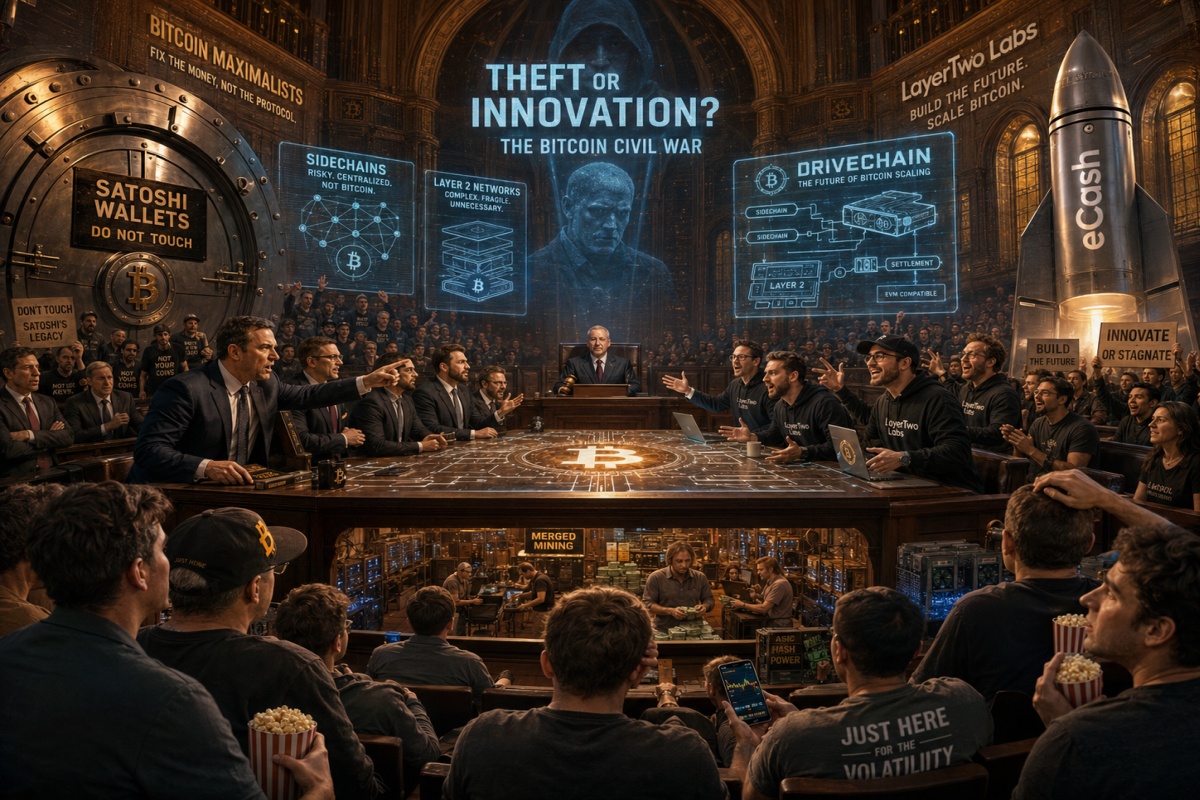
LayerTwo Labs sparks massive Bitcoin controversy after proposing eCash fork, Drivechains integration, and Satoshi coin redistribution plan.
The Bitcoin world has many unwritten rules. One of the biggest is simple: you do not touch Satoshi’s coins.
That social rule has survived countless forks, civil wars, block-size battles, and enough angry forum posts to power several small countries. But now, a controversial new proposal from LayerTwo Labs and Bitcoin developer Paul Sztorc is challenging one of Bitcoin’s oldest taboos—and the reaction has been exactly as calm and reasonable as you’d expect from the internet.
Which is to say: not calm at all.
The proposal centers around a planned August 2026 Bitcoin hard fork called eCash, a new blockchain network that would fork Bitcoin’s ledger, integrate multiple Drivechain-based Layer 2 systems, and—most controversially—reassign a large portion of coins linked to Satoshi Nakamoto on the new chain.
To critics, it’s “theft,” “disrespectful,” and a dangerous attack on Bitcoin’s core principles.
To supporters, it’s a necessary experiment designed to modernize Bitcoin, fund development, and prepare for future technological threats.
In other words, Bitcoin is having another philosophical crisis.
What Exactly Is eCash?
eCash is a proposed Bitcoin hard fork spearheaded by , founder of LayerTwo Labs and one of the most vocal advocates of Drivechains.
The fork is currently planned for August 21, 2026, around Bitcoin block height 964,000.
At launch, eCash would effectively copy Bitcoin’s existing blockchain ledger into a new network. Existing Bitcoin holders would receive an equivalent amount of eCash tokens on the new chain via a 1:1 allocation.
So if someone owns 2 BTC at the time of the fork, they would also receive 2 eCash tokens on the new network.
Importantly, supporters emphasize that the Bitcoin mainnet itself would remain untouched. Your BTC would still be BTC.
That distinction matters because the controversy is not about altering Bitcoin directly. It’s about what happens on the newly created forked chain.
And that’s where things get spicy.
The Core Goal: Bringing Drivechains to Bitcoin
The primary technical motivation behind eCash is the implementation of Drivechains, a scaling and sidechain concept Sztorc has promoted since 2015 through BIP300 and BIP301 proposals.
The idea behind Drivechains is relatively simple in theory but deeply controversial in practice:
- Keep Bitcoin’s main layer relatively stable
- Move experimentation and advanced features onto sidechains
- Allow miners to secure those sidechains through merged mining
- Expand Bitcoin functionality without changing Bitcoin Core directly
Supporters argue this could massively improve Bitcoin’s scalability and flexibility while preserving the security of the main chain.
Critics argue it introduces additional complexity, miner power concentration, and unnecessary risks.
Which means it fits perfectly into Bitcoin discourse.
Nothing unites Bitcoiners quite like deeply technical arguments conducted with the emotional intensity of medieval warfare.
The Seven Layer 2 Networks Planned for eCash
According to LayerTwo Labs and public project descriptions, eCash would launch with seven built-in Drivechain ecosystems already under development.
These reportedly include:
- Truthcoin — prediction markets
- CoinShift — decentralized exchange infrastructure
- BitAssets — NFT and asset systems
- BitNames — decentralized identity tools
- Photon — quantum-resistant systems
- Privacy-focused sidechains similar to Zcash
- Additional programmable Layer 2 environments
The broader vision is ambitious: transforming Bitcoin into a multi-layer ecosystem capable of supporting applications, scalability, privacy systems, and large-scale global usage without directly changing Bitcoin’s base rules.
Essentially, Sztorc wants Bitcoin to evolve without forcing Bitcoin itself to evolve.
Which is honestly one of the most Bitcoin solutions imaginable.
The Satoshi Coin Controversy
Now we arrive at the part that turned Bitcoin Twitter into a digital flamethrower.
Under the proposed eCash distribution model, coins associated with wallets believed to belong to would not receive a full 1:1 allocation on the new eCash chain.
Roughly speaking:
- Satoshi-linked wallets are believed to contain approximately 1.1 million BTC
- Only about 600,000 eCash would reportedly remain assigned to equivalent Satoshi addresses
- Roughly 500,000 eCash would instead be redirected to early investors and development funding
Importantly, this redistribution would occur only on the new eCash chain, not on Bitcoin itself.
No BTC would allegedly move or be modified.
But philosophically, many Bitcoiners still see the idea as crossing a sacred line.
Why Supporters Defend the Redistribution
Sztorc and supporters argue the redistribution is not theft because Bitcoin ownership on the actual Bitcoin chain remains completely intact.
Their argument essentially works like this:
- eCash is a completely separate blockchain
- No BTC is taken from anyone
- The new chain can define its own monetary distribution rules
- The redirected coins fund development and long-term sustainability
Sztorc also argues that previous Bitcoin forks already created “free” forked assets for Satoshi’s addresses, effectively giving dormant wallets enormous allocations on every new chain.
From his perspective, reallocating some of those coins on the new chain is simply a pragmatic funding mechanism.
He has also described the move as necessary to avoid creating a “zombie project” with insufficient incentives and weak long-term development funding.
Supporters additionally point to concerns about dormant legacy wallets and future quantum computing threats. Some believe old Satoshi-era addresses may eventually become vulnerable if cryptographic standards weaken over time.
And yes, Bitcoin somehow managed to combine a civil war about property rights with hypothetical quantum apocalypse discussions.
Classic Tuesday.
Why Critics Are Furious
Opponents believe the proposal fundamentally violates Bitcoin’s social contract.
Their argument is not primarily technical—it’s philosophical.
Critics argue that Bitcoin’s legitimacy depends heavily on the principle that ownership cannot be arbitrarily altered, regardless of whether coins are active, dormant, lost, or associated with Satoshi himself.
Many prominent Bitcoin voices reacted aggressively to the proposal.
publicly described the idea as “theft” and “disrespectful.”
Others warned that once a community accepts altering dormant balances—even on a fork—it creates a dangerous precedent.
The fear is simple:
If a community becomes comfortable reallocating “inactive” coins on one chain, what stops future groups from targeting other wallets later?
Today it’s Satoshi.
Tomorrow it’s “wallets inactive for 10 years.”
And eventually someone on social media proposes seizing your coins because you forgot your Ledger password during vacation.
The Bitcoin Identity Crisis Returns
The controversy around eCash taps into one of Bitcoin’s oldest unresolved tensions:
Should Bitcoin prioritize immutability above everything else, or should it evolve aggressively to compete technologically?
This argument has existed for more than a decade.
Previous conflicts produced:
- Bitcoin Cash
- Bitcoin SV
- SegWit wars
- Block-size debates
- Taproot controversies
- Ordinals and inscriptions disputes
Now Drivechains and eCash have become the newest battlefield.
Supporters see Bitcoin as too conservative and technologically stagnant.
Critics see Bitcoin’s conservatism as its greatest strength.
Both sides think they’re saving Bitcoin from disaster.
Which means the ecosystem is functioning normally.
The Technical Risks and Operational Concerns
Beyond the ideological debate, several developers raised practical concerns regarding the fork itself.
Some warned about:
- Replay protection issues
- Potential user confusion
- Coin-splitting complexity
- Exchange support uncertainty
- Miner incentives
- Security risks on low-hashrate chains
Replay protection is particularly important during forks because transactions valid on one chain can sometimes unintentionally execute on another chain if protections are weak.
LayerTwo Labs reportedly plans to release dedicated coin-splitting tools before launch.
Still, many critics worry ordinary users could accidentally expose themselves to scams, phishing attempts, or operational mistakes during the fork process.
Because if there’s one thing crypto absolutely excels at, it’s making simple things technologically stressful.
Will Exchanges and Miners Support eCash?
One major unanswered question is whether exchanges, miners, custodians, and wallets will meaningfully support the fork.
Historically, most Bitcoin forks have struggled long-term despite massive initial attention.
Bitcoin Cash and Bitcoin SV both achieved temporary relevance but eventually lost significant market influence relative to Bitcoin itself.
eCash supporters believe the addition of functional Layer 2 systems and merged-mining economics could give the project stronger long-term utility than previous forks.
Critics believe the fork will ultimately suffer the same fate as many prior Bitcoin splinters:
A brief explosion of drama followed by gradual market indifference.
Which, to be fair, is also how many reality TV shows end.
The Quantum Computing Angle
One of the stranger—but increasingly serious—subplots involves quantum computing.
Some supporters argue that old Bitcoin wallets using early cryptographic standards could eventually become vulnerable if sufficiently advanced quantum computers emerge.
This has fueled broader debates around dormant wallet security and whether future Bitcoin ecosystems should proactively migrate coins into quantum-resistant systems.
Critics argue these fears remain speculative and should not justify rewriting ownership assumptions.
Still, the fact that Bitcoin debates now regularly include phrases like “post-quantum cryptography” proves the ecosystem has evolved slightly beyond arguments about internet magic money.
Slightly.
The Market Reaction So Far
So far, market reactions appear more philosophical than financial.
Bitcoin itself has not experienced catastrophic volatility because of the proposal, though analysts noted increased discussion around ownership assumptions and dormant wallet narratives.
The larger impact may ultimately be cultural rather than economic.
Because the eCash controversy forced Bitcoiners to confront uncomfortable questions:
- What truly defines ownership?
- How immutable should forks remain?
- Who gets to decide legitimacy?
- Can Bitcoin evolve without losing its identity?
These are not easy questions.
And Bitcoin communities historically answer difficult questions by arguing about them continuously for several years.
Could eCash Actually Succeed?
That depends entirely on adoption.
For eCash to survive long-term, it would likely need:
- Meaningful miner participation
- Exchange support
- Developer activity
- Strong Layer 2 usage
- User interest beyond the initial controversy
The project’s strongest advantage may be its focus on functionality rather than simply increasing block sizes or replaying old Bitcoin political battles.
If Drivechains and sidechain systems gain traction, eCash could potentially become a large-scale experimental Bitcoin ecosystem.
Or it could become another historical footnote in Bitcoin’s endless collection of ideological experiments.
Crypto history contains examples of both outcomes.
The Bigger Picture
Regardless of whether eCash ultimately succeeds, the controversy reveals something important about Bitcoin’s current stage of development:
Bitcoin is no longer merely a technology project.
It is now a global ideological system with deeply entrenched beliefs about ownership, immutability, governance, and legitimacy.
And once technology becomes ideology, debates stop being purely technical.
They become emotional.
Very emotional.
For readers tracking controversial developments, emerging blockchain ecosystems, and evolving crypto narratives across the industry, additional curated articles and partner projects can be explored here: Article partners
What This Means
The proposed eCash fork is far more than another Bitcoin clone. It represents a direct challenge to some of Bitcoin’s deepest philosophical assumptions.
Supporters believe the project could unlock innovation, scalability, and sustainable ecosystem funding through Drivechains and Layer 2 experimentation. Critics believe it undermines the very principles that make Bitcoin valuable in the first place.
The biggest controversy is not whether eCash can technically function. It’s whether Bitcoin communities are willing to tolerate a fork that redefines how dormant balances are treated—even on a separate chain.
And perhaps that’s the real story here:
Bitcoin’s hardest debates are no longer about code alone.
They’re about identity, principles, and who gets to decide what “Bitcoin” actually means.
Related Articles
More stories you may want to explore.



Sponsored Placements











