
Bitcoin Breakout Faces Its Real Test
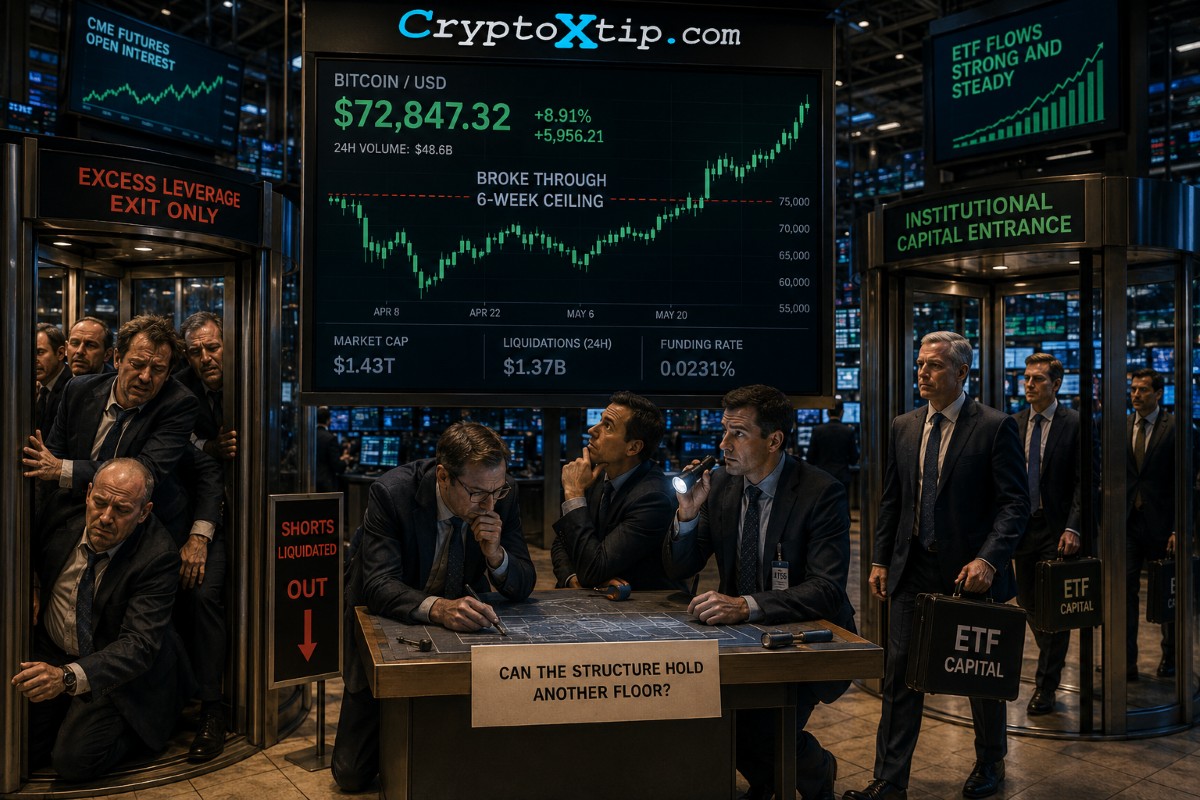
Bitcoin has delivered its strongest week since 2023, but traders are now asking whether ETF demand can turn a short squeeze into a lasting rally.
Bitcoin has just delivered the kind of week that can rapidly change the mood of an entire market. After breaking out of a trading range that had contained price action for roughly six weeks, BTC pushed above $77,000 and recorded gains of about 24% from the start of the week, marking its strongest weekly performance since 2023.
The speed of the move was striking. Bitcoin cleared several closely watched technical levels in quick succession and briefly traded substantially higher during the advance. Altcoins followed, while bearish derivatives positions were caught on the wrong side of an increasingly aggressive rally.
That last point matters. A significant portion of the initial acceleration came from a short squeeze rather than purely organic spot buying. Decrypt reported roughly $1.21 billion in bearish crypto positions were liquidated over one 24-hour period as Bitcoin surged. Forced buying can produce spectacular candles, but it cannot provide permanent fuel.
The more encouraging development arrived elsewhere: U.S. spot Bitcoin exchange-traded funds have returned to substantial net inflows. That gives the rally something considerably more useful than liquidated shorts—a visible source of fresh demand.
Bitcoin Finally Breaks the Range
Bitcoin's breakout followed weeks of frustrating consolidation in which repeated attempts to establish stronger momentum failed. That environment encouraged bearish positioning and gave traders increasing confidence that resistance would continue holding.
Then the market moved through it.
Bitcoin climbed above $77,000 during Friday trading after having already cleared $69,000 on Wednesday and $72,000 on Thursday. CoinDesk reported that BTC had gained roughly 24% since Monday, making this its strongest week since 2023.
The technical structure also helped attract momentum traders. CoinDesk noted that Bitcoin reached a target associated with an inverse head-and-shoulders breakout, while price moved back above its 200-day simple moving average.
Those signals have encouraged discussion that Bitcoin may have established a local bottom following the weakness that dominated previous months.
That interpretation is plausible. It is not yet proven.
The Short Squeeze Was Enormous
One reason for caution is the composition of the rally.
Decrypt reported that Bitcoin's sharp advance triggered approximately $1.5 billion in cryptocurrency liquidations during a 24-hour period, with around $1.21 billion coming from short positions. Nearly 179,000 traders were affected across the market.
A short squeeze occurs when traders betting on falling prices are forced to close positions as the market rises. Closing a short requires buying the underlying exposure back, which creates additional demand. That pushes prices higher, forcing more shorts to exit and potentially creating a self-reinforcing cycle.
It is one of crypto's more efficient methods of turning skepticism into rocket fuel.
The problem is that liquidation-driven demand eventually runs out. Once heavily leveraged bearish positions have been cleared, the market needs another source of buyers to continue advancing.
That is why the next stage of Bitcoin's rally matters more than the first.
ETF Demand Changes the Picture
Fortunately for bulls, the latest ETF data provides a more constructive signal.
U.S. spot Bitcoin ETFs recorded approximately $606 million in net inflows on August 20, according to data reported by Decrypt. It was their largest single-day inflow since May 1 and extended the funds' positive streak to four consecutive trading sessions.
BlackRock's IBIT dominated the session, attracting approximately $503 million—around 83% of the day's total Bitcoin ETF inflows. Fidelity's FBTC, Bitwise's BITB and ARK 21Shares' ARKB also recorded positive flows, while VanEck's product posted a comparatively small outflow.
More importantly, the four-day inflow streak totaled roughly $1.61 billion.
That is fundamentally different from a derivatives squeeze.
ETF inflows represent capital deliberately seeking Bitcoin exposure. While flows can reverse quickly and should never be treated as guaranteed long-term demand, sustained inflows provide a healthier foundation for a rally than traders simply being forced out of losing positions.
For bulls, this is arguably the most important development of the week.
Has Bitcoin Found a Bottom?
The obvious question is whether Bitcoin's recent lows represented a meaningful local bottom.
There are reasons to consider the possibility seriously. Bitcoin escaped a prolonged trading range, reclaimed major technical levels, punished excessive bearish positioning and attracted renewed institutional demand through ETFs.
The broader environment has also become more supportive. Recent developments in U.S. financial policy and improving liquidity expectations have contributed to stronger risk appetite, while regulatory conditions for digital assets have become more constructive than during previous periods of market stress.
Yet declaring a new bull market after one exceptional week would be premature.
Bitcoin remains well below its previous record high, and a substantial portion of the rally was initially powered by positioning rather than sustained spot accumulation. Technical breakouts can fail, particularly after unusually rapid moves when traders begin taking profits.
A confirmed price breakout and a confirmed new market cycle are not the same thing.
Spot Demand Is the Next Test
The quality of demand will therefore become increasingly important.
If ETF inflows remain positive and broader spot-market buying continues after the short squeeze fades, the argument for a more durable recovery becomes considerably stronger. Investors would then have evidence that capital is entering Bitcoin because buyers want exposure, not merely because bears need to close positions.
Conversely, if ETF flows weaken and spot demand fails to expand, Bitcoin could struggle to maintain the pace of its recent advance.
This distinction is particularly important after such a dramatic weekly move. Rapid rallies often create fear of missing out among investors who had remained on the sidelines. That can extend momentum, but it can also produce unstable positioning if buyers enter primarily because prices have already risen.
Markets are remarkably good at making patience feel foolish immediately before reminding everyone why patience exists.
Institutional Flows Matter More Now
Bitcoin's market structure has changed substantially since the launch of U.S. spot ETFs in 2024.
ETF flows now provide investors with a daily window into one important segment of institutional and brokerage demand. They are not a complete measure of the market—Bitcoin trades globally across exchanges, OTC desks and derivatives venues—but they have become too significant to ignore.
The concentration of recent inflows in BlackRock's IBIT is also noteworthy. Decrypt reported that the fund accounted for roughly $1.09 billion of the $1.61 billion that entered U.S. Bitcoin ETFs over the four-session positive streak.
Strong demand through one dominant product can support the market, although broader participation across funds would arguably provide a more diversified signal of investor conviction.
For traders following Crypto X Tip and the wider market, ETF flows are therefore likely to remain among the most useful indicators for judging whether this breakout is developing deeper institutional support.
Volatility Is Not Finished
None of this means Bitcoin is suddenly entering a smooth upward trend.
The market has moved extremely quickly, and sharp advances frequently produce equally sharp periods of consolidation. Traders who accumulated Bitcoin near recent lows may take profits, while previously liquidated short sellers may eventually return if momentum begins weakening.
Macroeconomic conditions remain relevant as well. Interest-rate expectations, Treasury market liquidity, inflation and broader risk sentiment continue influencing crypto alongside industry-specific developments.
The strongest bullish scenario would involve Bitcoin holding above its former trading range while ETF and spot demand remain constructive. A weaker scenario would see institutional flows fade as the derivatives-driven momentum exhausts itself.
For now, the evidence supports optimism with conditions attached—the traditional financial-market method of saying everyone is bullish but still keeping one hand near the exit.
What This Means
Bitcoin's strongest week since 2023 is a meaningful technical and psychological shift. The breakout above $77,000 ended a six-week range, erased a large amount of bearish leverage and brought momentum back into a market that had struggled for direction.
The return of substantial spot Bitcoin ETF inflows makes the rally more convincing. Roughly $606 million entered U.S. funds on August 20 alone, while the four-session inflow streak reached approximately $1.61 billion. That provides evidence of genuine investment demand alongside the spectacular short squeeze.
Still, one strong week does not confirm a new bull market. The next test is whether spot and ETF demand persist once forced short covering is no longer doing the heavy lifting. Bitcoin has confirmed the breakout. Now the market has to prove it can stay there.
Related Articles
More stories you may want to explore.



Sponsored Placements











