
From High-Speed Blockchain to Global Web3 Powerhouse
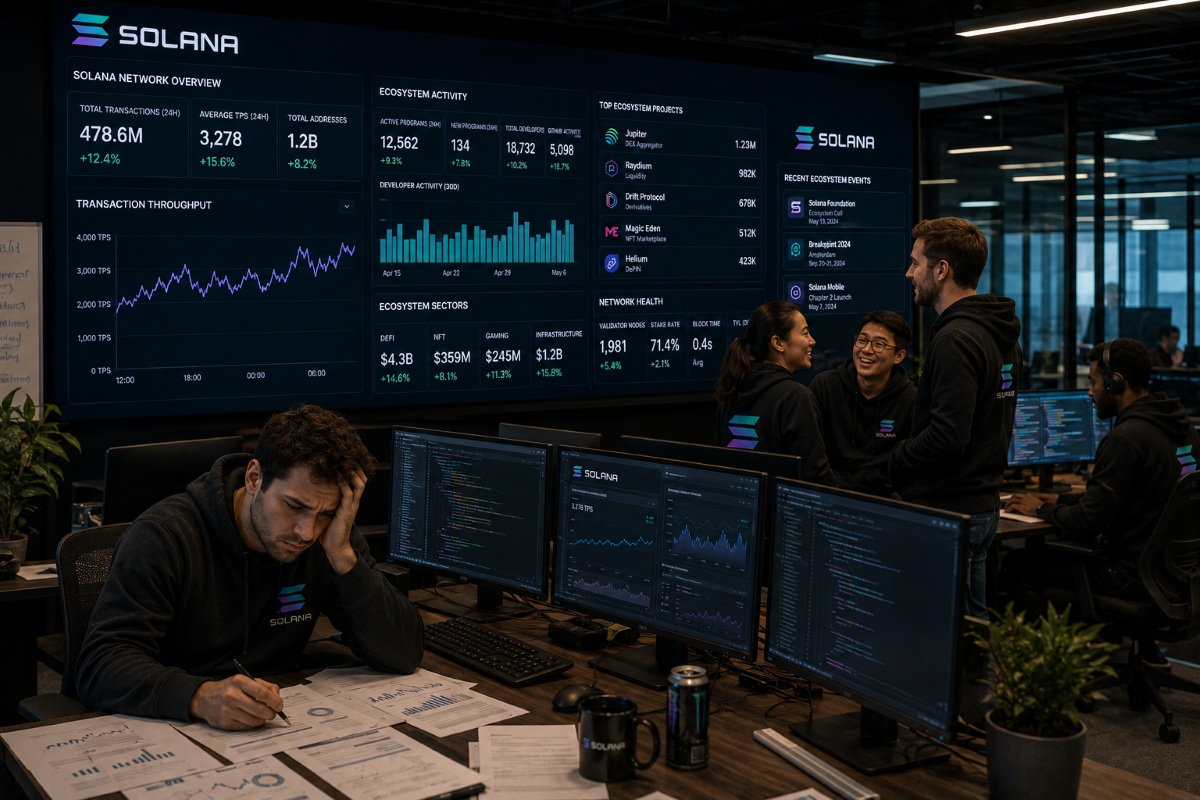
How Solana pursued scalability, speed, and adoption while reshaping blockchain infrastructure.
The Origins of Solana
Solana was created to solve one of the biggest challenges in blockchain technology: scalability.
By the late 2010s, blockchain networks such as Bitcoin and Ethereum had demonstrated the power of decentralized systems, but they also faced limitations. Transaction throughput was relatively low compared to traditional payment networks, and fees could become expensive during periods of heavy usage.
Enter Anatoly Yakovenko, a software engineer with experience at Qualcomm and other technology companies. In 2017, Yakovenko published a whitepaper describing a new approach to blockchain scalability called Proof of History (PoH).
The concept proposed a cryptographic method for creating a verifiable sequence of time on a blockchain. Rather than requiring every participant to constantly agree on the order of events, the network could use cryptographic timestamps to establish transaction order more efficiently.
This innovation became one of the foundational technologies behind Solana.
Yakovenko was later joined by several former Qualcomm colleagues, including Greg Fitzgerald and Stephen Akridge. Together, they began building what would become the Solana blockchain.
The project was named after Solana Beach, California, a location where several early team members had spent time surfing and discussing technology.
Not every blockchain gets named after a beach. Some projects choose technical names. Solana chose sunshine and ocean waves.
The Vision Behind Solana
From the beginning, Solana's goal was ambitious.
The team wanted to create a blockchain capable of supporting global-scale applications without sacrificing speed or requiring expensive infrastructure for users.
Its objectives included:
- High transaction throughput
- Low transaction costs
- Fast confirmation times
- Support for decentralized applications
- Scalability without extensive layer-based complexity
Rather than focusing exclusively on digital payments, Solana was designed as a platform capable of supporting decentralized finance, gaming, NFTs, infrastructure projects, and various Web3 applications.
Proof of History Explained
One of Solana's most distinctive innovations is Proof of History.
Importantly, Proof of History is not a consensus mechanism by itself. Instead, it works alongside Solana's Proof of Stake system.
Proof of History creates a cryptographic record that helps establish when events occurred.
This approach reduces the amount of communication required between validators and allows the network to process transactions more efficiently.
Combined with Proof of Stake, the system was designed to achieve significantly higher throughput than many earlier blockchain networks.
The concept quickly attracted attention because blockchain developers had spent years trying to improve scalability without compromising security.
Solana's answer was essentially:
"What if we could make time itself part of the blockchain architecture?"
That tends to get people interested.
Launching the Network
After several development and testing phases, Solana's mainnet beta launched in March 2020.
The launch occurred during a period of increasing interest in decentralized finance and smart contract platforms.
At the time, Ethereum dominated the smart contract sector, but growing network congestion and rising fees created opportunities for competing platforms.
Solana entered the market emphasizing:
- Speed
- Low fees
- Developer flexibility
- Scalability
Early adoption was modest compared to larger networks, but developer interest steadily increased.
The Growth of the Solana Ecosystem
During 2020 and 2021, Solana experienced rapid ecosystem growth.
Developers began building applications across multiple categories:
- Decentralized finance (DeFi)
- NFT marketplaces
- Blockchain gaming
- Infrastructure tools
- Payment systems
- Decentralized exchanges
The network's low transaction costs became one of its most attractive features.
While some blockchain users occasionally found themselves paying substantial fees elsewhere, Solana users often completed transactions for fractions of a cent.
Needless to say, this gained attention.
Few things attract blockchain users faster than hearing the words:
"The transaction fee is practically negligible."
The DeFi Expansion
Decentralized finance became one of Solana's major growth drivers.
Projects launched across lending, borrowing, trading, liquidity provision, and derivatives markets.
Several prominent Solana-based protocols emerged, helping expand the ecosystem's financial infrastructure.
Developers were particularly attracted by:
- Fast transaction finality
- Low operating costs
- Scalability potential
- Growing user adoption
The rapid expansion helped position Solana as one of the most significant smart contract ecosystems outside Ethereum.
NFTs and Digital Culture
Solana also became a major participant in the NFT boom.
During 2021 and beyond, NFT projects, digital art collections, gaming assets, and creator platforms increasingly adopted the network.
The lower transaction costs allowed creators and collectors to interact with blockchain applications without paying the higher fees often associated with more congested networks.
NFT marketplaces built on Solana attracted substantial activity during periods of intense market interest.
As with much of the NFT industry, opinions varied dramatically.
Some saw revolutionary digital ownership.
Others saw expensive profile pictures.
Entire family dinners were sacrificed trying to explain the difference.
Solana's Performance Advantage
One of Solana's defining characteristics has always been performance.
The network was engineered to support high transaction throughput under normal operating conditions.
Supporters frequently highlighted:
- High transaction capacity
- Fast confirmation times
- Low fees
- Scalability-focused architecture
This performance profile made Solana attractive for applications requiring frequent user interactions, including gaming, payments, and high-volume trading systems.
Many developers viewed speed as essential for mainstream adoption.
After all, users generally enjoy waiting for coffee. They do not enjoy waiting for transactions.
Network Outages and Reliability Challenges
Despite its technological achievements, Solana also faced significant challenges.
Between 2021 and 2023, the network experienced several outages and performance disruptions.
These incidents became one of the most discussed aspects of Solana's history.
Causes varied and included:
- Network congestion
- Validator coordination issues
- Software bugs
- Unexpected transaction surges
Critics argued that reliability concerns raised questions about scalability.
Supporters countered that rapidly growing infrastructure often requires extensive refinement.
The Solana development community subsequently implemented numerous upgrades designed to improve network stability and resilience.
Few things motivate software engineers quite like millions of users watching every uptime statistic.
The FTX Crisis and Its Impact
One of the most difficult periods in Solana's history occurred in late 2022 following the collapse of the cryptocurrency exchange FTX.
FTX and its affiliated trading firm Alameda Research had significant connections to the Solana ecosystem.
When FTX entered bankruptcy proceedings, uncertainty spread throughout cryptocurrency markets.
Solana's ecosystem experienced substantial pressure during this period.
Market confidence declined, project funding became more difficult, and public sentiment weakened considerably.
Many observers questioned whether Solana could recover.
However, the network continued operating, developers continued building, and community activity persisted despite challenging conditions.
The period ultimately became one of the ecosystem's most important resilience tests.
The Recovery and Renewed Growth
Throughout 2023 and 2024, Solana experienced a significant resurgence.
Developer activity increased, user adoption expanded, and ecosystem participation recovered.
Several factors contributed to renewed momentum:
- Improved network reliability
- Growing developer communities
- Expanding DeFi applications
- Increased stablecoin activity
- Continued NFT ecosystem development
The recovery surprised many critics who had assumed the ecosystem would struggle to regain relevance.
Blockchain history has repeatedly demonstrated that predicting permanent winners and losers is harder than it looks.
Solana and Consumer Applications
A major focus of the Solana ecosystem has been consumer-facing applications.
Developers increasingly targeted products intended for mainstream audiences rather than only cryptocurrency specialists.
Examples included:
- Mobile applications
- Gaming platforms
- Social applications
- Payment services
- Digital commerce tools
The network's speed and low fees made these use cases particularly attractive.
The goal was clear:
Make blockchain technology feel less like advanced engineering and more like ordinary software.
Developer Ecosystem and Innovation
One of Solana's greatest strengths has been its developer community.
Thousands of developers have contributed to tools, applications, infrastructure, and educational resources.
The ecosystem supports innovation across numerous sectors:
- Decentralized finance
- Artificial intelligence integrations
- Gaming
- Payments
- Tokenization
- Data infrastructure
- Consumer applications
Hackathons, grants, accelerators, and community programs helped attract builders from around the world.
In blockchain, developers are often the real long-term asset.
They tend to keep building regardless of market cycles, headlines, or social media drama.
Competition in the Smart Contract Industry
Solana operates in an extremely competitive environment.
It competes with major blockchain ecosystems including:
- Ethereum
- BNB Chain
- Avalanche
- Cardano
- Polygon
- Sui
- Aptos
Each network offers different trade-offs involving decentralization, scalability, developer experience, and governance.
Solana's primary competitive advantage has consistently centered on performance and cost efficiency.
Whether that advantage remains decisive over the long term continues to be one of the industry's major debates.
Solana Today
As of 2026, Solana remains one of the largest blockchain ecosystems in the cryptocurrency industry.
The network supports:
- Thousands of decentralized applications
- Large DeFi ecosystems
- NFT marketplaces
- Gaming projects
- Payment platforms
- Infrastructure providers
- Developer tools
SOL serves as the native token used for transaction fees, staking, validator participation, and ecosystem operations.
The blockchain continues evolving through protocol improvements and ecosystem expansion.
The Broader Legacy of Solana
Solana's story reflects one of the central themes of modern blockchain development: the pursuit of scalability.
The project demonstrated that alternative blockchain architectures could challenge conventional assumptions about performance.
Its history includes:
- Technical innovation
- Rapid growth
- Network challenges
- Market volatility
- Ecosystem resilience
- Continuous development
Whether Solana ultimately becomes a dominant global blockchain platform remains uncertain.
What is already clear is that it has played a major role in pushing the industry toward faster and more scalable infrastructure.
Conclusion
From Anatoly Yakovenko's original Proof of History concept in 2017 to a globally recognized blockchain ecosystem, Solana has become one of the most influential projects in cryptocurrency.
Its combination of speed, affordability, and developer activity helped establish it as a leading smart contract platform.
The network faced technical setbacks, market challenges, and intense competition, yet continued evolving and expanding.
Supporters view Solana as a foundation for the next generation of internet applications.
Critics continue to debate trade-offs involving reliability and decentralization.
Regardless of where those debates ultimately lead, Solana has already secured its place in blockchain history.
And somewhere right now, a developer is probably launching a new application on Solana while explaining for the hundredth time that Proof of History is not actually a time machine.
Sponsored content: This article was published in cooperation with Crypto Reporter.
Partner
Crypto Reporter