
Solana Draws Institutions Despite DeFi Security Scare
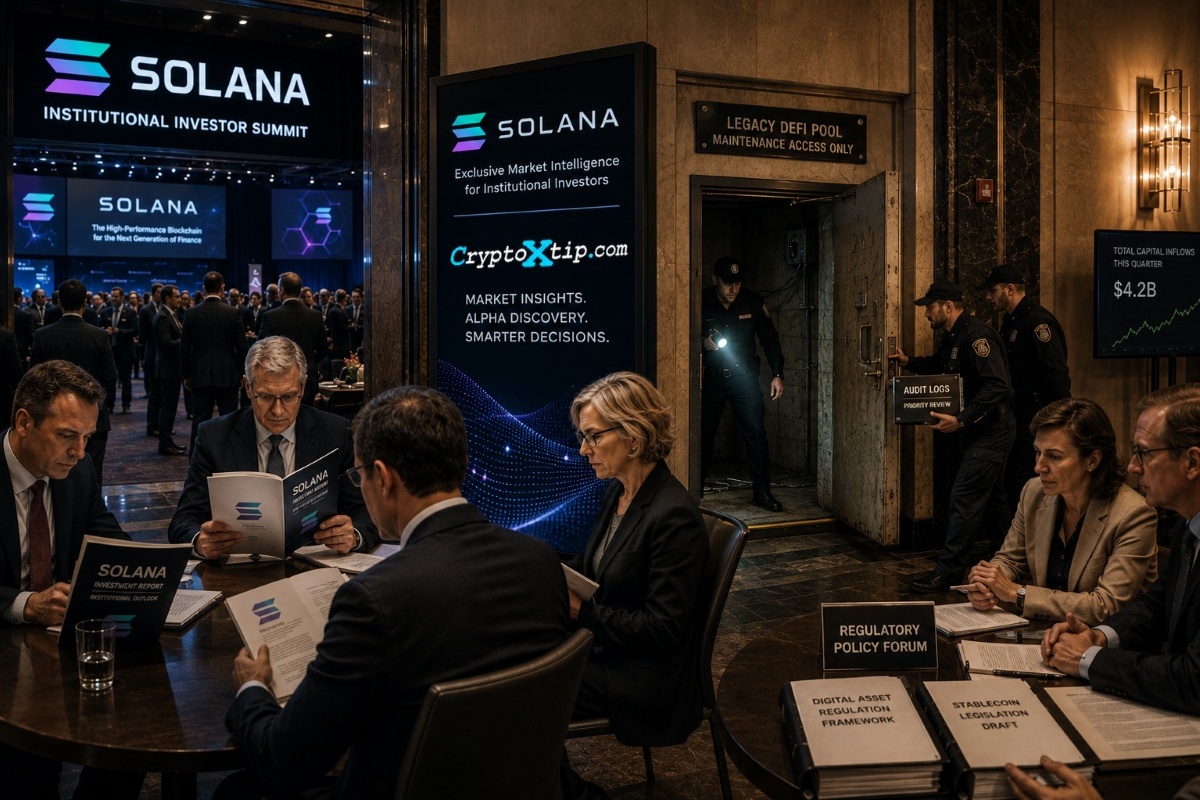
Institutional interest in Solana is rising as ETF flows improve, even as a Raydium exploit highlights persistent DeFi security risks and regulatory uncertainty.
Solana has emerged as one of the most closely watched assets in the crypto market over recent weeks. While broader digital asset sentiment remains heavily influenced by macroeconomic uncertainty and shifting capital flows, Solana has found itself at the center of several narratives that extend well beyond short-term price action.
Institutional investors are increasingly exploring Solana-focused investment products, a trend that has gained attention as some capital rotates away from certain Bitcoin ETF vehicles. At the same time, a security incident involving legacy Raydium liquidity pools has reminded market participants that decentralized finance still carries operational risks, even on mature networks.
Adding another layer to the story, organizations connected to the Solana ecosystem have become active participants in the regulatory debate surrounding the proposed CLARITY Act in the United States. The legislation could play a significant role in defining how digital assets are regulated for years to come.
Taken together, these developments illustrate a network entering a more complex phase of its evolution. Solana is no longer simply competing for developer attention or retail speculation. It is increasingly navigating the challenges that accompany institutional adoption, regulatory engagement, and large-scale financial activity.
Institutional Capital Continues to Explore Solana
The conversation surrounding Solana has shifted noticeably compared with previous market cycles. Historically, Solana was often discussed primarily through the lens of technical performance, transaction throughput, and retail trading activity. Today, institutional participation has become a far more prominent theme.
Several asset managers and financial firms have expanded their focus beyond Bitcoin and Ethereum, exploring investment vehicles tied to alternative blockchain networks. Solana has emerged as one of the most prominent beneficiaries of this broader diversification trend.
The growing attention reflects a changing perception of the network. Institutional investors increasingly view blockchain ecosystems through a practical lens, evaluating developer activity, stablecoin infrastructure, tokenization potential, and network usage rather than focusing exclusively on market capitalization rankings.
Solana's appeal stems partly from its ability to support high-volume applications at relatively low transaction costs. This has allowed the network to attract activity across decentralized finance, payments, consumer applications, and tokenized assets. For investors seeking exposure beyond Bitcoin, Solana increasingly represents a liquid and established alternative rather than a purely speculative bet.
The shift is particularly notable as some market observers have reported capital moving selectively toward alternative crypto investment products while flows into certain Bitcoin-focused vehicles have moderated. Such rotations are common during periods when investors begin searching for growth opportunities beyond the largest assets in the sector.
That does not necessarily indicate a broader institutional preference for Solana over Bitcoin. Rather, it highlights a more nuanced market environment where professional investors are gradually building diversified exposure across multiple blockchain ecosystems.
The Raydium Incident Highlights a Familiar DeFi Challenge
Even as institutional interest grows, recent events have demonstrated that blockchain adoption does not eliminate operational risk.
A recent exploit involving older Raydium automated market maker pools drew attention across the Solana ecosystem. According to publicly available information, the incident affected legacy infrastructure and resulted in relatively limited losses compared with many historic DeFi exploits.
Importantly, reports indicated that active users and current liquidity providers were not broadly impacted by the vulnerability. The issue appeared to be associated with older pool implementations rather than the platform's actively maintained infrastructure.
While the financial damage was contained, the event served as a useful reminder of an uncomfortable reality that continues to accompany decentralized finance. Smart contracts may be transparent, but transparency alone does not eliminate risk.
One of the recurring lessons from DeFi history is that forgotten code can become just as dangerous as newly deployed code. Legacy contracts often remain accessible on public blockchains long after attention has shifted elsewhere. In traditional finance, old software can be retired behind corporate firewalls. In decentralized finance, yesterday's code often remains permanently visible and potentially exploitable.
The Solana ecosystem has made substantial progress in security practices over recent years. Auditing standards have improved, developer tooling has matured, and security firms have become increasingly involved in protocol reviews. Even so, incidents involving legacy infrastructure continue to emerge across multiple blockchain networks.
For investors, the lesson is less about Solana specifically and more about DeFi as a whole. Security remains a process rather than a destination. Every network, regardless of scale or reputation, continues to face evolving technical threats.
Regulation Moves Closer to Center Stage
Alongside institutional adoption and security discussions, regulatory developments have become a major focus for the Solana ecosystem.
Supporters of the network have actively engaged with policymakers regarding the proposed CLARITY Act, legislation intended to establish clearer regulatory frameworks for digital assets in the United States. The proposal seeks to address longstanding uncertainty regarding the classification and oversight of crypto assets and blockchain-based projects.
For years, one of the most persistent complaints from industry participants has been the lack of clear rules governing digital assets. Companies frequently argue that uncertainty discourages innovation, complicates compliance efforts, and creates challenges for institutional participation.
The CLARITY Act aims to provide more predictable regulatory boundaries by clarifying responsibilities among federal agencies and establishing definitions that could help distinguish different categories of blockchain assets.
Solana ecosystem advocates have emerged among the voices supporting efforts to create clearer standards. Their involvement reflects a broader shift within the crypto industry. Whereas earlier generations of blockchain projects often viewed regulation primarily as an obstacle, many major networks now see regulatory clarity as a prerequisite for large-scale adoption.
The change in attitude is not surprising. Institutional investors generally prefer environments where legal obligations are clearly defined. Pension funds, asset managers, banks, and public companies rarely deploy significant capital into sectors governed by uncertainty.
A clearer regulatory framework could potentially accelerate investment across the digital asset industry by reducing compliance ambiguity and providing firms with more confidence when developing blockchain-based products.
Why Solana's Position Is Evolving
The convergence of these developments reveals how Solana's role within the broader crypto market is changing.
In earlier cycles, the network was frequently judged based on technical benchmarks, transaction metrics, or speculative enthusiasm. Those factors still matter, but they are increasingly being supplemented by institutional adoption trends, regulatory engagement, and ecosystem resilience.
This evolution mirrors a broader maturation process taking place across the crypto industry. As blockchain networks attract larger pools of capital, the conversation naturally expands beyond technology and market performance.
Questions about governance, security, compliance, and infrastructure become increasingly important. Investors begin evaluating networks not only on what they can do, but also on how reliably they can operate under growing scrutiny.
Solana's ability to maintain developer activity while attracting institutional attention has strengthened its position within that discussion. Yet the network also faces expectations that accompany greater visibility. Security incidents, governance debates, and regulatory developments now carry more weight because the ecosystem has become too significant to be viewed solely as an emerging experiment.
As often happens in financial markets, success tends to attract both capital and scrutiny in roughly equal measure.
What This Means
Solana's recent momentum reflects more than short-term market interest. The network is increasingly becoming part of institutional portfolio discussions, benefiting from growing attention toward alternative crypto investment products and broader blockchain diversification strategies.
At the same time, the Raydium exploit demonstrates that decentralized finance continues to face operational risks, particularly when legacy infrastructure remains accessible. The limited impact of the incident is encouraging, but it reinforces the importance of ongoing security vigilance.
The network's involvement in discussions surrounding the CLARITY Act may ultimately prove just as important as ETF-related developments. Regulatory clarity has become one of the most valuable assets the crypto industry can pursue, particularly as institutional participation expands.
For investors, Solana's story is increasingly about infrastructure, regulation, and adoption rather than pure speculation. Market sentiment will continue to fluctuate, but the long-term trajectory may depend less on daily trading activity and more on whether the ecosystem can successfully navigate the responsibilities that come with becoming a major financial network.
In crypto, attention often arrives first. The real challenge begins when institutions decide to stay.
Related Articles
More stories you may want to explore.



Sponsored Placements











