
Solana DeFi Learns Security the Hard Way
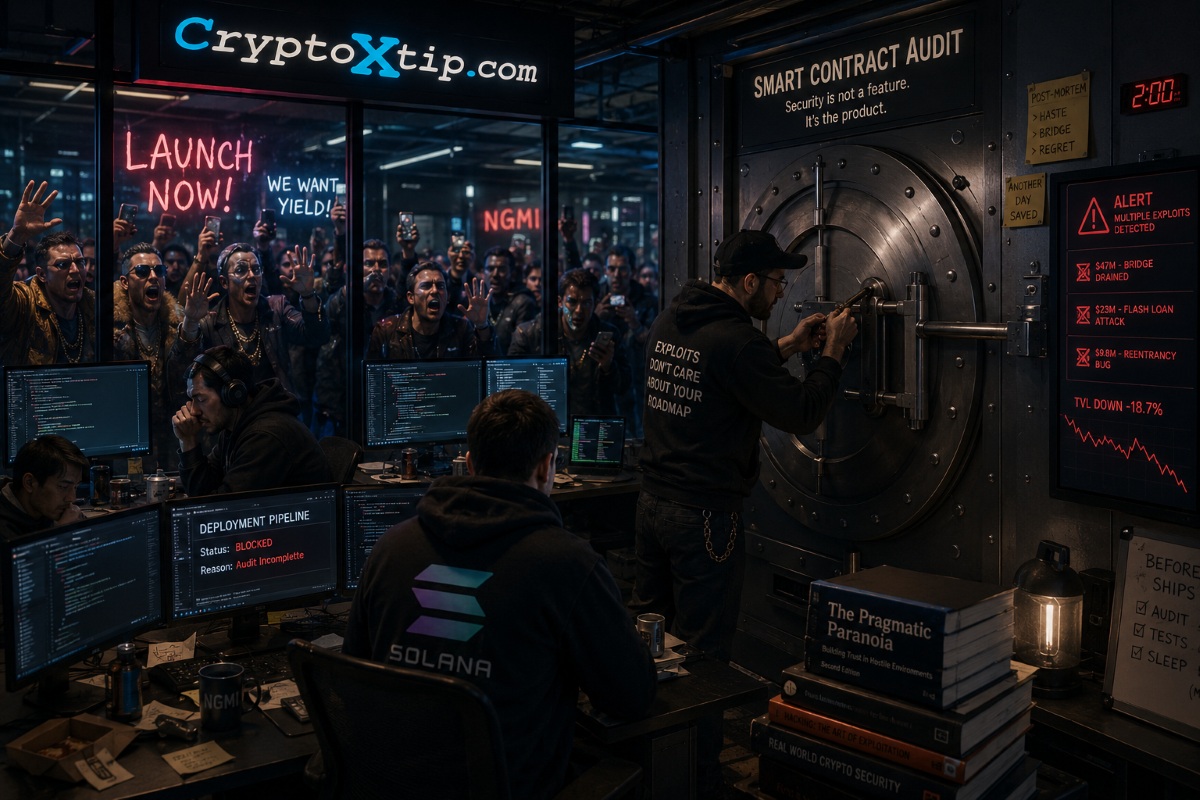
After years of exploits and rushed launches, Solana’s DeFi ecosystem is treating smart contract security as a survival requirement rather than a marketing checkbox.
The Solana ecosystem spent years selling speed.
Fast transactions. Fast execution. Fast user growth. Fast token launches. Occasionally, unfortunately, fast exploits as well.
By 2026, the conversation around Solana DeFi has shifted noticeably. Community discussions that once focused almost exclusively on throughput, memecoin velocity and total value locked are increasingly dominated by a less glamorous subject: security.
The change did not happen because the industry suddenly became cautious. Crypto rarely changes its personality that dramatically. It happened because repeated exploits, infrastructure compromises and wallet-draining attacks forced both developers and investors to confront an uncomfortable reality. In decentralized finance, one overlooked vulnerability can erase years of growth in minutes.
Recent incidents involving Solana-based projects have kept pressure on the ecosystem throughout 2026. Earlier attacks against protocols including Drift and Step Finance renewed concerns about treasury management, smart contract architecture and operational security practices across DeFi platforms.
The broader crypto market has seen this pattern repeatedly. Bull markets reward speed. Bear markets reward discipline. Security usually becomes fashionable right after funds disappear.
Security Is Becoming the Main Competitive Advantage
Solana’s rise created a high-performance environment that attracted traders, developers and liquidity providers seeking lower fees and faster execution than Ethereum-based alternatives.
That growth also created pressure to launch products quickly.
Many DeFi teams competed aggressively for liquidity and user attention during previous cycles, often prioritizing feature releases and ecosystem expansion over exhaustive security testing. Venture capital funding rewarded growth metrics, while communities frequently treated audits as symbolic milestones rather than ongoing operational processes.
The consequences became increasingly visible.
According to multiple blockchain security firms and recent industry reporting, exploits across decentralized finance continued causing substantial losses through 2025 and into 2026. Analysts from Chainalysis and several cybersecurity researchers have repeatedly warned that rapid DeFi expansion often outpaces security infrastructure.
The Solana ecosystem has faced particular scrutiny because its architecture differs significantly from Ethereum’s account model and smart contract framework. Researchers publishing recent academic studies on Solana security vulnerabilities noted that the network introduces unique attack surfaces tied to account permissions, signer validation and cross-program interactions.
In other words, building fast decentralized applications turns out to be slightly more complicated than deploying a token and adding neon-colored dashboards.
The challenge is not necessarily that Solana is uniquely insecure. Rather, the ecosystem’s rapid growth exposed weaknesses common throughout DeFi while introducing additional technical complexity specific to Solana’s architecture.
Recent research into symbolic execution and automated vulnerability detection for Solana smart contracts has highlighted how subtle coding mistakes can create severe financial risks. Missing owner checks, flawed permission logic and unsafe cross-program interactions remain recurring concerns for auditors reviewing Solana-based applications.
The Drift and Step Finance Incidents Changed Sentiment
Several major incidents over the past year appear to have accelerated the industry’s shift toward security-focused development.
Reports surrounding the attack on Drift Protocol earlier in 2026 described losses potentially reaching hundreds of millions of dollars, making it one of the most serious incidents associated with the Solana DeFi ecosystem this year. Security analysts suggested the attack involved sophisticated manipulation tactics and operational weaknesses rather than a simple isolated bug.
The Step Finance breach earlier this year also drew significant attention after attackers reportedly compromised executive devices and gained access to treasury assets.
That distinction matters because not every crypto exploit begins with faulty smart contracts. Increasingly, operational security failures, phishing attacks, social engineering and compromised infrastructure are proving just as dangerous as on-chain vulnerabilities themselves.
Crypto investors often imagine hackers discovering dramatic lines of malicious code inside futuristic command centers. In reality, many attacks still begin with something far less cinematic: a compromised laptop, weak internal permissions or someone clicking the wrong link after three hours of sleep and two governance meetings.
The industry’s growing focus on “full-stack security” reflects this broader understanding.
Security now extends beyond audits and includes:
- Treasury management procedures
- Multi-signature controls
- Access management systems
- Employee operational security
- Real-time monitoring tools
- Bug bounty programs
- Formal verification methods
- Cross-chain bridge protections
Several security firms operating in the blockchain sector have expanded services around continuous monitoring rather than one-time audits. Companies like CertiK, Hacken, BlockSec and Certora increasingly position security as an ongoing lifecycle process instead of a single pre-launch event.
That evolution reflects hard lessons learned across DeFi.
Audits Alone No Longer Reassure Investors
For years, many DeFi projects treated audits almost like marketing accessories.
A protocol would secure funding, announce a partnership with a well-known auditor and present the audit itself as proof of safety. Communities often interpreted the existence of an audit as a guarantee rather than a probability reduction exercise.
The market has become more skeptical.
Recent industry analysis has shown that even audited protocols continue suffering major exploits. In some cases, vulnerabilities emerged from changes introduced after audits were completed. In others, exploits involved operational weaknesses entirely outside the smart contract review process.
This has created a more mature, if less optimistic, understanding of DeFi security.
Audits remain essential, but they are increasingly viewed as baseline requirements rather than comprehensive protection.
Institutional participants entering crypto markets appear especially focused on this distinction. As larger financial firms explore tokenization, stablecoin settlement and blockchain-based financial infrastructure, security expectations are beginning to resemble traditional enterprise software standards.
That shift may ultimately reshape how DeFi projects compete for capital.
Protocols with stronger security reputations increasingly attract more durable liquidity, particularly from sophisticated investors managing larger allocations. The market is slowly rewarding reliability over pure hype cycles, although crypto still occasionally struggles to resist shiny objects with questionable tokenomics.
Some Solana developers are responding by integrating formal verification tools, automated testing systems and external security competitions earlier in development cycles. Bug bounty programs are also expanding as protocols attempt to incentivize white-hat researchers before attackers discover vulnerabilities first.
Additional ecosystem coverage from Crypto X Tip has increasingly reflected this broader industry transition toward infrastructure quality and operational resilience rather than purely speculative narratives.
Why Solana Faces Unique Security Pressure
Solana occupies an unusual position within crypto markets.
The network remains one of the most active blockchain ecosystems for trading activity, consumer-facing applications and high-frequency DeFi usage. Its speed and relatively low transaction costs continue attracting developers and users despite recurring concerns about outages and security incidents.
That activity concentration also makes Solana an attractive target.
Attackers generally follow liquidity. The more capital flows through an ecosystem, the greater the incentives for sophisticated exploit attempts.
Security researchers have also noted that Solana’s programming environment differs substantially from Ethereum’s Solidity ecosystem. Developers transitioning from EVM-compatible chains may misunderstand aspects of Solana’s account structure, permission systems or execution logic.
The ecosystem’s rapid onboarding of new developers during previous bull cycles likely amplified this issue.
Some academic research published in 2025 and 2026 suggested that automated vulnerability detection tools for Solana still lag behind the maturity of Ethereum-focused security tooling. While that gap is narrowing, it highlights how quickly Solana’s ecosystem expanded relative to its surrounding infrastructure.
Meanwhile, the broader geopolitical environment surrounding crypto security continues becoming more complicated. Reports from financial media and blockchain investigators increasingly link sophisticated crypto theft operations to organized cybercrime groups and state-affiliated actors.
That escalation changes the threat landscape significantly.
Modern DeFi protocols are no longer defending themselves against isolated hobbyist attackers. In some cases, they face highly coordinated organizations with substantial technical resources, financial incentives and operational patience.
What This Means
Security has become one of the defining themes of the Solana ecosystem in 2026 because the market no longer treats exploits as isolated accidents.
Investors, developers and institutions increasingly understand that smart contract security is fundamental infrastructure rather than optional optimization.
The Solana ecosystem still offers some of the fastest and most active decentralized applications in crypto. But speed alone is no longer enough to sustain long-term trust.
Protocols that survive the next phase of DeFi growth will likely be the ones capable of balancing innovation with operational discipline. That includes better audits, stronger internal controls, continuous monitoring and a willingness to slow down deployment timelines when necessary.
Ironically, the industry built around decentralization is gradually rediscovering one of traditional finance’s oldest lessons: markets function best when participants believe the doors are locked at night.
For Solana DeFi, 2026 increasingly looks like the year security stopped being a side discussion and became the product itself.
Related Articles
More stories you may want to explore.



Sponsored Placements











