
Ronin’s Ethereum L2 Shift Marks a Surprising Comeback
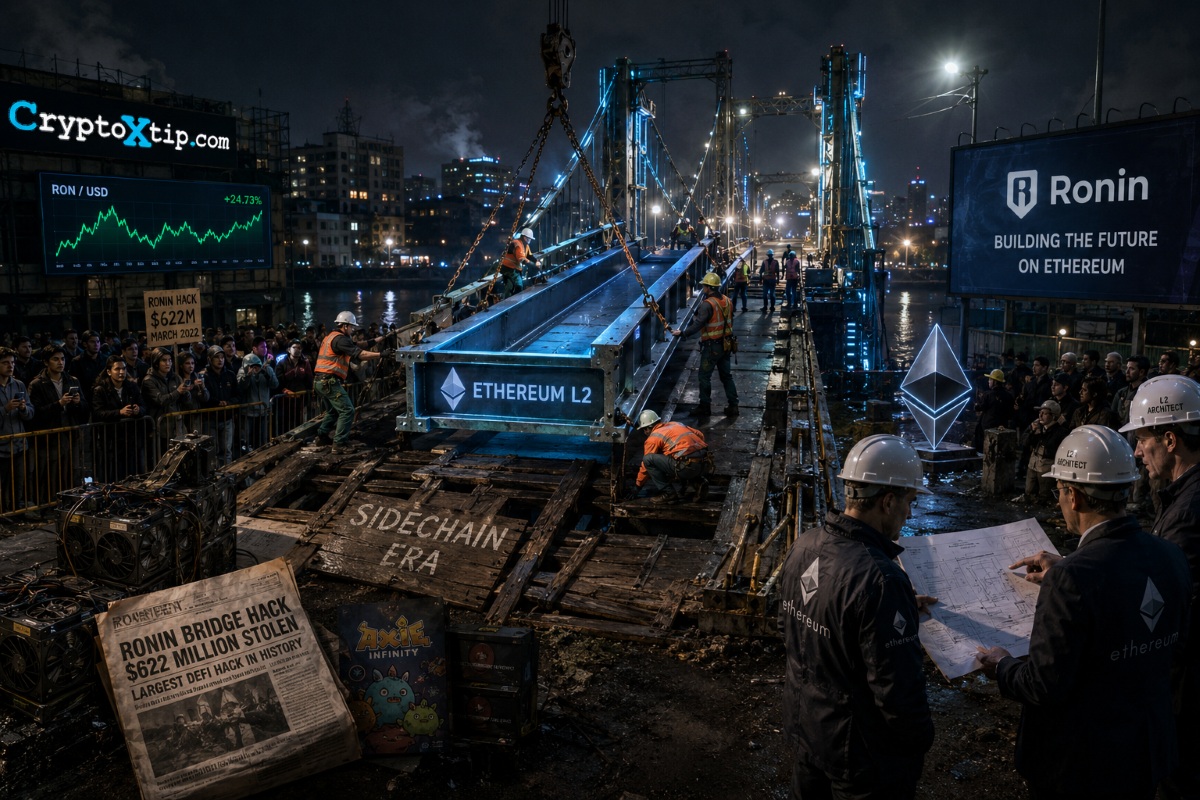
Ronin is transitioning from an independent Ethereum sidechain into a Layer 2 network, a move that strengthens Ethereum’s expanding L2 ecosystem while reshaping the reputation of a blockchain once defined by one of crypto’s largest bridge hacks.
Few blockchain networks understand reputational damage quite like Ronin.
For much of the past three years, the network remained synonymous with one of crypto’s most infamous security failures: the 2022 bridge exploit that drained more than $600 million worth of assets and exposed the fragility of early cross-chain infrastructure.
Now, Ronin is attempting something more ambitious than simple recovery.
The gaming-focused blockchain announced plans to evolve from an independent Ethereum sidechain into an Ethereum Layer 2 network, aligning itself more directly with the ecosystem it originally tried to scale away from.
The move carries technical implications, strategic symbolism and a noticeable reputational undertone. For Ethereum supporters, it represents another example of the network’s growing gravitational pull over blockchain infrastructure. For Ronin, it marks an attempt to reposition itself not as an isolated gaming chain with historical baggage, but as part of Ethereum’s broader modular future.
Crypto markets tend to have short memories during bull cycles. Infrastructure, unfortunately, remembers everything.
Why Ronin Is Moving Toward Ethereum L2
Ronin was originally launched by Sky Mavis, the creator of Axie Infinity, as a dedicated Ethereum sidechain optimized for blockchain gaming.
At the time, the rationale was straightforward. Ethereum’s base layer struggled with high fees and limited throughput, while gaming applications required faster and cheaper transactions to support mainstream user activity.
Ronin succeeded in solving part of that problem. During the peak of the Axie Infinity boom, the network became one of the most heavily used gaming chains in crypto.
Its architecture, however, came with trade-offs.
Unlike Ethereum rollups that inherit parts of Ethereum’s security model, Ronin operated as a more independent sidechain with its own validator structure. That approach allowed for efficiency and lower costs but also introduced centralization concerns that became painfully relevant during the 2022 bridge attack.
The exploit exposed weaknesses in validator security and bridge architecture, ultimately becoming one of the largest hacks in crypto history. The incident triggered broader industry scrutiny around cross-chain infrastructure and accelerated demand for more secure scaling models.
The broader Ethereum ecosystem evolved rapidly afterward.
Rollup-centric scaling gained momentum, Layer 2 adoption accelerated and Ethereum increasingly positioned itself around modular infrastructure where execution occurs off-chain while settlement and security anchor back to Ethereum itself.
Ronin’s migration toward an Ethereum L2 reflects that broader industry direction.
Recent reporting from crypto media indicated the network plans to adopt a zkEVM-based architecture while integrating more closely with Ethereum’s security and liquidity environment. The transition is designed to improve interoperability while reducing some of the trust assumptions associated with standalone sidechains.
In practical terms, Ronin appears to be acknowledging what much of the market already concluded: Ethereum’s Layer 2 ecosystem has become the dominant scaling model for serious long-term infrastructure projects.
The Reputation Factor Still Matters
Ronin’s technical evolution cannot be separated from its history.
The 2022 exploit remains one of the defining security failures of the previous crypto cycle. U.S. authorities later linked the attack to North Korean hacking groups, turning the incident into both a cybersecurity crisis and a geopolitical story.
For many outside observers, Ronin became shorthand for the risks associated with bridge infrastructure and lightly decentralized validator systems.
That reputational shadow lingered long after the immediate market shock faded.
The move toward Ethereum Layer 2 architecture therefore carries symbolic importance beyond scaling efficiency. It allows Ronin to position itself within a security model that the market currently views as more credible and institutionally acceptable.
Ethereum’s rollup ecosystem increasingly functions as a kind of reputational umbrella for projects seeking legitimacy through alignment with Ethereum security standards.
That does not erase historical failures, of course.
Crypto has a habit of celebrating reinvention while quietly hoping nobody rereads the postmortems. The bridge exploit will remain part of Ronin’s history regardless of what architecture it adopts next.
Still, markets generally reward visible attempts at structural improvement, especially when those changes align with broader ecosystem trends.
Ronin’s challenge now is convincing developers, users and institutional observers that the network’s future identity matters more than its most infamous moment.
Why Ethereum Benefits From the Move
For Ethereum, Ronin’s transition represents another strategic win in the ongoing competition for blockchain infrastructure dominance.
The Ethereum ecosystem has increasingly embraced a thesis where Layer 2 networks become specialized execution environments while Ethereum itself functions as the settlement and security layer underneath.
Under that framework, the success of external ecosystems eventually becomes additive to Ethereum rather than competitive against it.
Ronin is particularly significant because it was not originally designed as an Ethereum rollup. It operated as an independent ecosystem optimized around gaming activity and user scalability.
Its migration toward Ethereum L2 architecture suggests the economic and security incentives around Ethereum alignment have become increasingly difficult to ignore.
This trend extends well beyond Ronin.
Across the industry, many newer chains increasingly prioritize interoperability with Ethereum liquidity and infrastructure rather than attempting to replace Ethereum entirely.
The result is a growing Layer 2 landscape where Ethereum captures value indirectly through settlement activity, liquidity gravity and ecosystem coordination.
Critics of Ethereum often argue that the expanding L2 ecosystem fragments liquidity and complicates user experience. Those criticisms remain valid in many respects.
Yet the market continues rewarding networks that position themselves inside Ethereum’s broader infrastructure orbit rather than outside it.
Ronin’s decision reinforces that dynamic.
It also highlights how Ethereum’s long-term strategy increasingly depends less on winning every application layer directly and more on becoming the default coordination layer underneath the broader crypto economy.
Gaming Remains Central to Ronin’s Identity
Despite the infrastructure shift, Ronin is still fundamentally tied to blockchain gaming.
The network continues positioning itself as a gaming-focused ecosystem optimized for consumer-scale activity, digital ownership and in-game economies.
That niche remains strategically important, even after the speculative excesses of the previous play-to-earn cycle cooled dramatically.
Blockchain gaming has spent the past two years undergoing a quieter reset. Investor enthusiasm declined after the collapse of many unsustainable token reward models, but development activity never disappeared entirely.
Instead, many gaming projects shifted toward infrastructure refinement, gameplay quality and more sustainable economic models.
Ronin survived that transition better than many expected.
The network retained a recognizable brand, continued onboarding developers and preserved enough ecosystem activity to remain relevant in blockchain gaming discussions.
Its Ethereum L2 transition may therefore reflect not desperation, but adaptation.
Gaming chains face unique scaling demands compared to traditional DeFi applications. Fast transaction processing, low fees and smooth onboarding remain essential for broader adoption.
Ethereum’s Layer 2 ecosystem increasingly offers a path toward achieving those goals without forcing projects into isolated security models.
That balance matters because mainstream gaming adoption likely depends less on ideological blockchain purity and more on whether users barely notice the infrastructure underneath at all.
Most gamers do not particularly care whether transactions settle through a sidechain, zk-rollup or optimistic rollup. They care whether the system works consistently and cheaply.
Crypto infrastructure debates, by contrast, sometimes resemble theological disputes conducted through GitHub repositories.
The Risks Behind the Transition
Ronin’s shift toward Ethereum Layer 2 architecture does not guarantee success.
The Layer 2 landscape has become increasingly crowded, with networks competing aggressively for developers, liquidity and user activity.
Many Ethereum rollups now offer similar promises around scalability, low fees and ecosystem interoperability.
Differentiation is becoming harder.
Ronin still benefits from its gaming identity and established brand recognition, but the network will now operate inside a much more competitive infrastructure environment.
There are also execution risks tied to any major architectural transition. Migration complexity, validator coordination, bridge security and ecosystem compatibility all create potential operational challenges.
The irony is unavoidable: a network historically associated with bridge vulnerabilities must now convince the market it can execute another infrastructure transition securely.
Ethereum itself also continues facing unresolved questions around Layer 2 fragmentation, interoperability standards and long-term fee economics.
The broader rollup-centric vision remains influential, but parts of the ecosystem still debate whether Ethereum’s growing dependence on external scaling layers ultimately weakens the simplicity of the network experience.
Ronin’s migration becomes part of that larger experiment.
Still, the direction of travel across crypto infrastructure appears increasingly clear. Security alignment with Ethereum is becoming more valuable than maintaining complete architectural independence.
That reality may frustrate some blockchain maximalists, but markets rarely prioritize ideological purity over economic gravity for very long.
Additional ecosystem coverage from Article Partners continues tracking how Ethereum’s Layer 2 expansion is reshaping competitive dynamics across gaming, DeFi and broader blockchain infrastructure.
What This Means
Ronin’s transition from an independent Ethereum sidechain into a Layer 2 network represents more than a technical upgrade.
It reflects a broader shift in how blockchain infrastructure is evolving after years of experimentation, security failures and ecosystem fragmentation.
For Ronin, the move offers a path toward rebuilding credibility through closer alignment with Ethereum’s security and liquidity environment. The network still carries the historical weight of one of crypto’s largest bridge exploits, but its willingness to adopt a more integrated architecture signals a clear strategic reset.
For Ethereum, the migration strengthens the argument that Layer 2 infrastructure is becoming the dominant long-term scaling model across the industry.
Projects that once pursued independent ecosystems are increasingly deciding that access to Ethereum’s settlement layer, developer network and liquidity base outweighs the benefits of standing alone.
That trend may ultimately become one of Ethereum’s strongest competitive advantages.
The transition is not risk-free. Layer 2 competition remains intense, technical execution matters enormously and users are unlikely to reward infrastructure complexity for its own sake.
Even so, Ronin’s pivot says something important about the direction of crypto markets in 2026: after years of fragmentation, the industry increasingly appears to be consolidating around fewer dominant infrastructure standards.
Ethereum continues positioning itself at the center of that consolidation.
Related Articles
More stories you may want to explore.



Sponsored Placements











